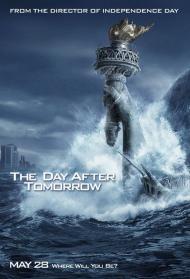




A good disaster movie needs two things; scenes that make you go, "Whoa!" and characters you care enough about to be concerned over whether they live or die when the disasters strike. The Day After Tomorrow excels at the first, but fails at the second, due to clichéd situations and some fairly two-dimensional characters. It also tends to beat you over the head with its message, leaving very little for the audience to work out for themselves.
Despite its failings, the movie still manages to entertain, at least for the first hour or so, when the special effects take center stage.
Starting with the collapse of an ice shelf in the Antarctic, it skips quickly through a Global Warming conference in India where the oversimplified science that is used to explain the sudden change in weather is laid out for the viewer. Very rapidly, it then moves around the globe showing the effects of tornadoes, hail larger than softballs, and temperatures dropping so fast that helicopters plummet out of the sky as their fuel freezes. We are also introduced to the stars of the film, including Jack Hall (Quaid), a climatologist, who plays this movie's Chicken Little.
Roland Emmerich is no stranger to big budget disaster films, having previously directed Independence Day and Godzilla. He uses this experience to good effect in the movie's most impressive sequences, destroying several major cities with sadistic glee. Los Angeles is flattened by massive tornadoes, but it is New York that is hit the hardest. The Big Apple is bombarded by torrential rains, gigantic tidal waves, blinding snowstorms, and a cold snap so great that its force pops out every window in the Empire State Building. In fact, these scenes of disaster are so amazing that once the storms begin to abate, so will your interest. Without a solid emotional foundation, the movie has nowhere else to go, but downhill.
All we are left with are the embarrassing, poorly written, quieter human moments. No plot element is too clichéd to use in an attempt to evoke some sympathy from the audience. The script even goes so far as to have a child dying of cancer stranded in a hospital as the last ambulance leaves without him. This, of course, forces Hall's doctor wife (Ward) to stay behind to care for the boy as the rest of the city is being evacuated. Hall meanwhile, is on his way to New York to rescue his son (Gyllenhaal) who is stranded in the Public Library. On his journey through the snow, Hall manages to have 'deep' conversations with his traveling companion in scenes that nearly have the word "message" flashing in neon at the bottom of the screen. Emmerich, who co-wrote the script, knows how to direct action sequences, but needs to leave the writing to someone with an ear for dialogue.
Hollywood blockbusters are often accused of being dumbed down spectacles intended for consumption by mass audiences. This isn't always the case. It is possible to produce quality big budget films that appeal to the mainstream moviegoing public. The recent Lord of the Rings trilogy is a good example. The Day After Tomorrow however, makes no attempt to put any intelligence or real emotion into its script, and instead relies strictly upon its special effects. And granted, they are impressive enough to almost make this movie worth the price of admission, but once they taper off, you might as well leave the theater rather than put up with the final, interminable hour of story.