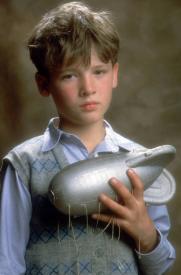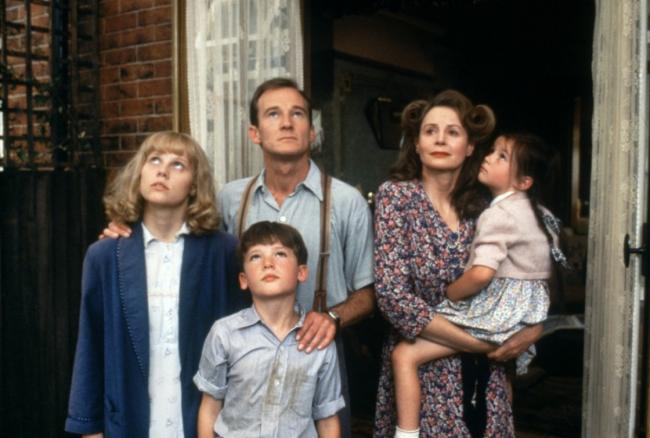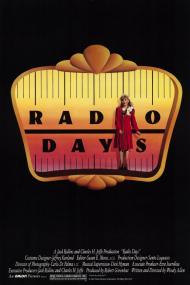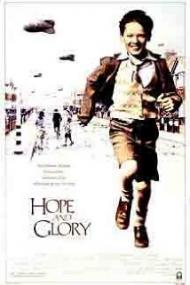



Hope and Glory reminded me of Woody Allen's Radio Days, also released in 1987. Both films revolve around a young boy and his extended family around the time of the start of World War II, with the story told from the boy's perspective. And both films cast the period in a nostalgic glow. Although this film isn't as outright a comedy as Radio Days, and the family is in more direct danger than the family in Radio Days, it does use levity to great effect to show the humorous side of life even in wartime.
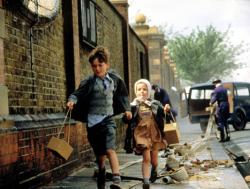
There isn't so much a plot to the film as there is a period of time in young Bill Rohan's life. He's around 10 years old when the film and the war begins. His father, despite being past conscription age, joins the army and Bill is left at home with his mother, along with his older and younger sister. His mother, Grace, decides to keep her children with her rather than send them away as many English parents did during the war. Bill witnesses the Blitz as homes in his area are bombed to rubble. Although he is often in danger, the situation is more of an adventure for him than a tragedy. He joins a gang of boys who explore the ruins and collect items they find, along with pieces of shrapnel and he develops his first crush on a neighbor girl.
For the older members of Bill's family, things are more serious, but we see their situation through Bill's eyes. He overhears conversations that he doesn't fully understand, but the audience does. His mother, before she was married, was in love with a man Bill thinks of as an uncle, and there are obviously still feelings there. His older sister has an affair with a Canadian soldier and becomes pregnant. While these events upset the family, in many ways it also strengthens it as the boundaries of polite convention are destroyed by the war.
Later in the story, Bill and his family move in with his grandparents. His grandfather, played by a scene stealing Ian Bannen, is grumpy and eccentric, seeing nothing wrong with shooting at rats with a shotgun during breakfast.
The cast is universally excellent. Surprisingly, this is Sebastian Rice-Edwards' only movie appearance. He does a great job as Bill, handling the comedy and light drama equally well. Sarah Miles is particularly good as Bill's mother as is Sammi Davis as his wild sister.
Many of the events in the film were inspired by writer/director John Boorman's own childhood experiences during the war. It's obviously a period in his life that he remembers with great fondness. Churchill called the early years of the war, when the United Kingdom stood alone against the Nazis, England's "Finest Hour" and it seems Boorman might agree with him. The title of the film comes from the patriotic English song by Elgar, "Land of Hope and Glory." It's Boorman's ability to wend humor through the dark days of the Blitz that makes this movie so special.
Although the story is similar to a coming of age tale, it's not fully one because Bill is still a child by the film's end, as evidenced by his joy at the conclusion where one of every child's fantasies comes true when his school is bombed. However, to hijack the Churchill quote that is featured in the film near its climax, "Now this is not the end of Bill's childhood. It is not even the beginning of the end. But it is, perhaps, the end of the beginning."
Last year, Boorman announced he was making a sequel, to be called Queen and Country, that will likewise be autobiographical, covering his time in the Korean War. If he can bring the same heart and humor to it as its predecessor, I'll be one of the first in line to see it.