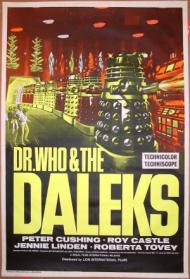



Doctor Who, the long running BBC science fiction series, debuted 50 years ago from the time of this writing, in 1963. Its second story featured the debut of the series' most famous villains, the robotic Daleks. Soon, the metallic voiced, psychopathic pepper pots, were rivaling the Doctor in terms of popularity, spawning a huge line of merchandise. To capitalize on this "Dalekmania", two theatrical movies were produced. Dr. Who and the Daleks, based roughly on that second story from the series, was the first of the two.
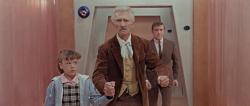
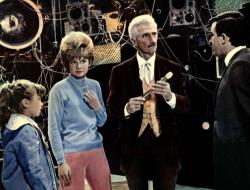
Wanting to attract new audiences as well as fans of the series, the producers decided to make the movie a stand-alone affair and so changed some key elements. Instead of casting William Hartnell, the actor playing the Doctor on television, as the Doctor in the movie, the producers went with Peter Cushing because he was deemed a bigger name. And rather than having the Doctor be a mysterious alien, he was written to be an absent minded professor from Earth. Other changes included making both Susan and Barbara, characters from the show, the Doctor's granddaughters, while Ian went from being a serious minded, chemistry teacher, to Barbara's bumbling boyfriend and the source of comic relief.
After the characters are introduced, the plot of the film follows the series more closely. The Doctor, or Dr. Who as he is literally named here, has invented a time/space machine and while showing it to his granddaughters, Ian bumps into a lever by mistake, sending the Tardis (as the ship is known) hurtling through time and space to a mysterious, dead planet. On this planet there are two races of beings. The Thals, a group of very 1960s looking hippies with lots of eyeliner and really bad haircuts, are one group, while the warlike Daleks are the other. As in the series, the Doctor is soon caught up in the affairs of another world.
Over the years Doctor Who has developed a grown-up following and the producers of the show have changed the series to please that older audience, but originally it began as strictly a children's show and this movie is very much in that vein. The comic relief, mostly provided by Ian, is of the silly, slapstick variety. Although there's some action and even death, there's no blood or serious tension. Despite being transported to another world, none of the characters act in anyway impressed or surprised. They simply accept it with a shrug.
Despite their popularity, the Daleks have always been slightly silly villains. They're a very awkward shape and as many comedians pointed out over the years, a simple staircase would be able to cause them difficulties. At least in this story, their shape and weakness makes sense. Their robotic shell is there to protect the lifeform inside from the planet's radiation, while they draw their power from the metallic floors of their city. Despite future stories with the Daleks taking place all across the galaxy, their shape from this first story became such a part of them that their design has never really changed.
One of the big draws of the movie at the time of its release was that it was in color and on the big screen, while the series was still being produced in black and white. Watching it today, what once seemed new and exciting, now feels very dated. The Thals just scream "1960s" and the Daleks' control room looks like a Ken Adams' designed Bond villain lair.
Although it was made to attract a new audience, this is a movie that's really only ever going to be of interest to fans of the original Doctor Who series. Its entertainment value to those unfamiliar with the show is bound to be limited at best.