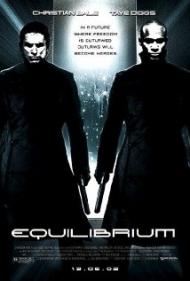


Equilibrium attempts to say something profound about human nature but winds up being just another derivative dystopian future flick that combines ideas borrowed from twentieth century literary classics (think Fahrenheit 451, Nineteen Eighty-Four, and Brave New World) with action fight scenes copied from The Matrix movies. An opening voice-over narration sets the scene, “In the first years of the 21st century, a third World War broke out. Those of us who survived knew mankind could never survive a fourth; that our own volatile natures could simply no longer be risked. So we have created a new arm of the law: The Grammaton Cleric, whose sole task it is to seek out and eradicate the true source of man's inhumanity to man - his ability to feel.”
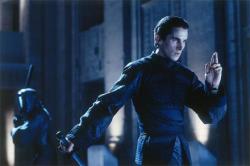
Christian Bale stars as John Preston, one such cleric. He enforces the law against sense offenders – anyone caught having an emotion – seeking them out and destroying their hidden stashes of art – all of which is considered contraband and outlawed. To not very subtly make this point, at the beginning of the movie there is a scene where John Preston finds and destroys the Mona Lisa. All the citizens of Libria are forced to take daily dosages of an emotion suppressing drug called Prozium. Their leader is a mysterious figure known simply as Father. He is never seen in public but appears only via large screens.
One day Preston's partner is caught reading (gasp) a book of poems by William Butler Yeats. Preston is shocked to discover that his partner was not only a sense offender but that he had ties to the underground rebel movement, which turns out to be -literally- right under the ground where they are standing. Will John Preston realize the error of his ways, begin to feel, and join the rebels? Hmm, I wonder? And will he at some point find an old Victrola and a phonograph record of Beethoven's 9th Symphony, listen to it and burst into tears? Maybe.
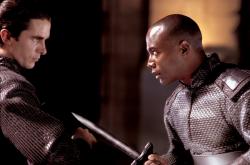
While this is a somewhat intriguing idea it doesn't translate easily to the screen. Think about it, you have a movie where the majority of the characters are supposed to be incapable of experiencing a genuine emotion. A complete lack of feeling is a difficult thing to act and quite dull to watch. Christian Bale does a decent job but Taye Diggs seems to be constantly smirking.
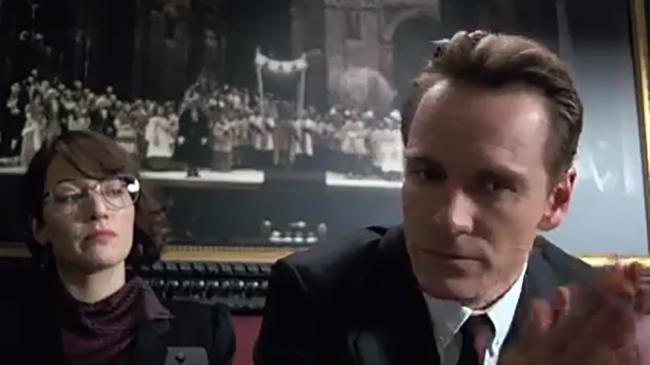
Emily Watson is the female lead. She plays a sense offender named Mary who's apprehended by John Preston. Together they have the best dialogue in the movie...
Mary: “Why are you alive?”
John Preston: “I'm alive... I live... to safeguard the continuity of this great society. To serve
Libria.”
Mary: “It's circular. You exist to continue your existence. What's the point?”
John Preston: “What's the point of your existence?”
Mary: “To feel. 'Cause you've never done it, you can never know it. But it's as vital as breath. And without it, without love, without anger, without sorrow, breath is just a clock... ticking.”
The Matrix style action sequences involve a new form of martial arts that combines karate with weaponry. It's called the gun katas and it enables someone to somehow miraculously dodge bullets at close range simply by learning the statistics of the different likely angles. It is never satisfactorily explained and is one of the sillier aspects of a movie that constantly walks the line between fantasy and ludicrousness.
The cinematography is nice and the sets are quite effective. Writer/director Kurt Wimmer (an American of German descent) shot many scenes at locations in Berlin, like Olympic Stadium, Deutschlandhalle, and the Brandenburg Gate in order to give the movie the right combination of “fascist” and “modern” architecture. The scenes set in the exterior of the city, where many of the rebels hide, were shot in partially dilapidated neighborhoods in East Berlin.
Equilibrium has its moments but overall it's a rehash of ideas put to better use elsewhere.