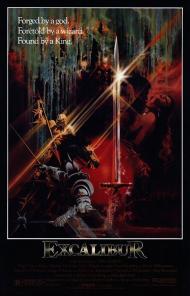



Director John Boorman had been developing a film adaptation of the Arthurian legend since 1969, but could find no studio willing to take on the project. Instead he was offered the chance to write and direct a version of the Lord of the Rings. When his script for that was rejected, being deemed too expensive to shoot, he returned once more to King Arthur and this time was able to seal a production deal.
The plot follows the familiar legend fairly closely with just a few minor alterations. It hits the highlights of Arthur's story, cramming as much as it can into one film. The story of his parents, Uther and Igraine, starts the film and then we skip ahead to the sword in the stone, then the formation of the Knights of the Round Table, including Arthur's meeting Lancelot and Guenevere. And of course all this is accomplished with the help of Merlin the Magician. The story continues with the quest for the Holy Grail and Lancelot and Guenevere's affair. It all leads up to the final battle between Arthur and his bastard son, Mordred, who he fathered on his half-sister Morgana Le Fay.
That's an epic story to cover in one film and if it were made today, it's one that would surely be split into a trilogy. It would be a smart move. Instead, this film tries to cover too much in its 2 hour and 20 minute running time. Certain aspects of the story feel rushed and skimmed over quite quickly. It can't have helped that Boorman's original cut was over 3 hours long, but was trimmed to shorten it.
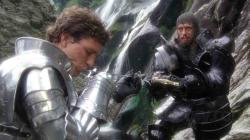
Perhaps the very best thing about Excalibur is the look of it. Filmed in Ireland, the locations are green and lush and quite beautiful to look at. The film's one and only Oscar nomination came for Cinematography. The production design and costumes do their best to match the beauty of the scenery. The armor is particularly well done. Constructed of aluminum, it gleams in different and ingenious designs. And the look of the film is accompanied by a soundtrack filled with the music of Wagner, that matches it perfectly.
The cast is mostly quite good. Nigel Terry, who was 35 at the time, manages to convincingly play Arthur as a young boy through to an older man. Helen Mirren plays Morgana with relish, but is unfortunately underused. Nicholas Clay as Lancelot is the film's weakest acting link. He's handsome enough, but he lacks the charisma needed to play Arthur's greatest Knight. There's a definite lack of chemistry between he and Cherie Lunghi, who played Guenevere. Although neither of them are helped by the script, leaving the love triangle portion of the story as one of the weakest plotlines.
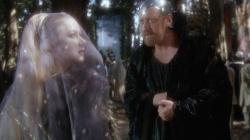
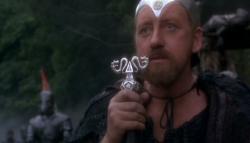
It is Nicol Williamson, as Merlin, who truly steals the film. His is the most intriguing character and Williamson plays the part to perfection. He has a great speaking voice and he uses it to great effect. He manages to be both threatening and provides a few moments of much needed comic relief. There's far more chemistry between Merlin and Morgana then there ever is between Lancelot and Guenevere. This may have been helped by the fact that reportedly Williamson and Mirren couldn't stand each other in real life, meaning some of the sparks between them are genuine.
Several supporting members of the cast were unknown when the film was made, but are quite famous today. Gabriel Byrne played Uther and Patrick Stewart has a small part as Arthur's father in-law. Ciaran Hinds has a very small part, while Liam Neeson plays Sir Gawain. Watching the film today, these parts standout much more than they did when the film was released.
Excalibur isn't a perfect film, although the first hour comes pretty damn close. The second half of the film is when it loses its way a bit. It's the darker half and it never feels as cohesive as the first half does. There's just too much story and it's not handled deftly enough.
Given the rise of fantasy films since the success of Peter Jackson's Lord of the Rings trilogy, I've been surprised that no one has tried to do another film version of the Arthurian legends. Until someone does, Excalibur, warts and all, will remain the definitive big screen adaptation.