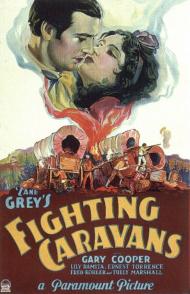



Fighting Caravans poster
Reviewed by all three buffs

Fighting Caravans (1931)

Directed by Otto Brower. Paramount Pictures. Starring Gary Cooper, Lili Damita, Ernest Torrence, Tully Marshall, Fred Kohler, Eugene Pallette, Charles Winninger, Roy Stewart.

Buffs' average★★2.2 / 4
Eric
★★½
“Fighting Caravans is a very old, yet still entertaining western.”
Patrick
★★
“Remembered today only because it stars Gary Cooper.”
Scott
★★
“A dated and lackluster old western”
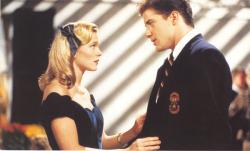
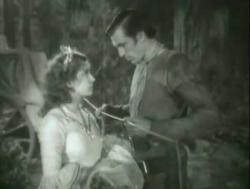
Lili Damita and Gary Cooper in Fighting Caravans.

Fighting Caravans is a very old, yet still entertaining western. It has one of the best stars of the golden era, Cooper. It has a big climactic fight with some Indians. It has two great comic relief characters. And just for good measure there is a love story thrown in as well.

Two old crusty scouts, Bill and Jim, along with a younger scout, Clint, that they raised, take a wagon train across the country during the early 1860s. Early in the movie, a French girl, Felice, is given a hard time about wanting to join the caravan as a single woman. When Clint gets into trouble with the law she pretends to be his wife in exchange for going along with the wagon train.

Once the wagon train makes a stop for the night, Clint comes on to Felice. He says that single people on a wagon train drink around a fire at night telling each other lies. The married folk go to bed, and since they are pretending to be married..... Felice turns him down, but Clint's parents, Bill and Jim, notice that they like each other and attempt to break them up. They tell the man in charge of the wagon train that they are not married in hopes that he will send Felice back. He doesn't and Clint and she spend the rest of the movie flirting and arguing as Bill and Jim scheme to keep them apart.

Bill and Jim give the movie most of its humor. They have lines like, "Any man who doesn't drink with us is a double bladdered skunk."and "You're shooting like a cross eyed squaw." They act like an old married couple. Years before Brokeback Mountain, Bill and Jim were gay cowboys. They raised a child together and were inseparable. They drink together and look to get into fights together. The movie, of course, never says that they are actually gay, but when they die in a shootout the one falls next to the other with his arm around him.

Fighting Caravans ends with a huge battle with some Indians at a river. Considering the name of the movie, I had hoped for more action than just the big finish. Early in the movie, a stagecoach passes the slow moving wagon train. A few scenes later they come across the burned remains of the stagecoach after it was attacked by Indians. Shortly thereafter, Bill, Jim and Clint go and attack the Indians and take the horses, from the stage, back. It never shows them do it. They just talk about it afterwards. There was plenty of room for more action in this movie but, for whatever reason, they left it out.

I know that westerns are not in vogue these days, but this movie, based on a Zane Grey story, could be remade into an exciting, action-filled film. Hell, you could even play up Jim and Bill's unrequited relationship for more laughs.
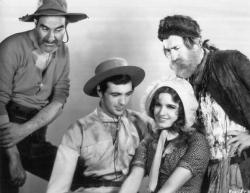
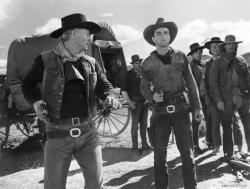
Ernest Torrence, Gary Cooper, Lili Damita and Tully Marshall in Fighting Caravans.

The Western genre has been around since The Great Train Robbery in 1903. During the 1920s several big-budget Westerns had been produced, most notably The Covered Wagon in 1923. The arrival of sound, however, ensured that it would remain a strictly B-movie genre for some time as early sound recording techniques seriously limited the range of movement in film. It would not be until 1939 with the one-two punch of John Ford's Stagecoach and Cecil B. DeMille's Union Pacific that the Western would truly achieve big-budget A-list prestige.

Fighting Caravans is one of dozens of B-movie Westerns made in those early talkie days. It is remembered today only because it stars Gary Cooper. The story is weak, it lacks action, and the acting is pretty bad. Gary Cooper hadn't yet fully developed his onscreen persona. Clint Belmet is goofier and a bit more of a dandy than the stoic, taciturn type Cooper would become known for playing.

Eric mentioned the lack of action and how some of it happens offstage. This probably had something to do with the cumbersome immobility of early recording equipment. Notice how most of the talking scenes have very little actual movement.

It was fun seeing Bill and Jim as an old gay couple. They are certainly inseparable and provide the movie with much-needed comic relief. They are easily the most entertaining characters in the movie.  Here's a sample of a conversation they have concerning Clint's behavior around Felice...

Bill Jackson: “He ain't been himself for the last three days. I've been watching him pretty close. Yesterday, he only had eleven drinks.”
Jim Bridger: “And he's been a-working too. Doing things he don't have to do.”
Bill Jackson: “She's got him all right.”
Jim Bridger: “Let's get drunk!”

Fighting Caravans is a minor entry in the venerable career of one of Hollywood's most enduring leading men, but other than that it is a completely forgettable little Western.

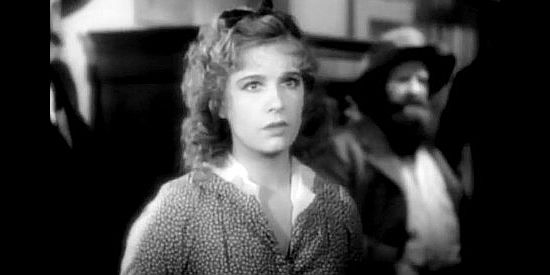
Lili Damita in Fighting Caravans

Seeing Bill and Jim, the comic relief characters, as gay is an interpretation the film never really supports, and I think my brothers are bringing personal bias to that particular aspect. While there’s nothing that says they aren’t gay, there’s certainly nothing in the film that says they are either. And putting it in a league with Brokeback Mountain is pure hyperbole. One thing neither of my brothers mentioned, even though Patrick mentioned the movie by name, is that Tully Marshall and Ernest Torrence had already played Jim and Bill in the 1923 film The Covered Wagon, which, as Patrick said, was clearly an inspiration for this movie. Apparently, they were so popular with audiences that they were brought back in this one. While I agree they do bring comic relief to the film, I could have done with a little less of them, to be honest. Their shtick loses its appeal with repetition.

Although the story is credited as being based on a Zane Grey story, in truth “inspired by” would be more accurate, as many of the details were changed, including the addition of Jim and Bill, who never appear in the original story. Grey was still a bestselling author at the time of this movie, and attaching his name to it seems more of a publicity grab than anything else.

I had never heard of the female lead, Lili Damita, before watching this film. Perhaps not too surprising considering she only has 37 acting credits between 1922 and 1938, many of them European. Today she seems to be remembered more for being Mrs. Errol Flynn from 1935 to 1942 in a tumultuous marriage where he reportedly cheated on her constantly, and he wrote of her violent temper in his autobiography. She’s quite attractive and charming in this film, and it’s easy to see why Gary Cooper’s Clint falls in love with her.

More recognizable than anyone but Cooper are two supporting parts. Prolific character actor Eugene Pallette (264 credits spanning 1913 to 1946), perhaps most remembered today as Friar Tuck in Errol Flynn’s The Adventures of Robin Hood, pops up as a fellow member of the wagon train for a few comical moments. And an uncredited Jane Darwell, most famous for winning the Oscar for playing Ma Joad in 1940’s The Grapes of Wrath, also makes a brief appearance as another member of the train.

I always enjoy watching pre-Code films to see which aspects wouldn’t have been allowed just a few years later. In this film, it’s the inclusion of the madam and her wagon full of would-be prostitutes who is heading west to set up a brothel. The script stops short of explicitly calling them such, but makes it plain that’s exactly what they are, with the madam proclaiming when they arrive in California that she didn’t come all this way to set up a marital agency, after 2 of the girls inform her they’re getting married.

As Patrick said, this is a very minor entry on Cooper’s list of credits, and only obsessive fans of his are likely to find much entertainment here. Perhaps that’s why both my brothers envisioned Jim and Bill as an old gay couple. There’s so little going on in the film to entertain you, it’s easy for the mind to wander and add a backstory that could only have improved this rather dull western.

8,666Reviews
3,766Movies
269Articles
2000Reviewing since