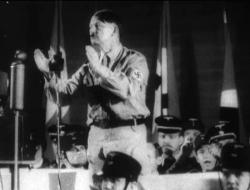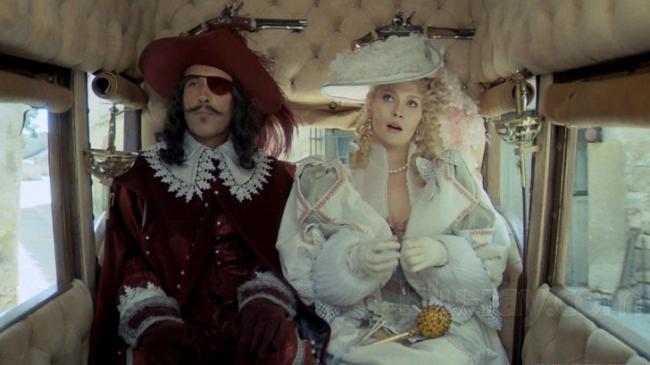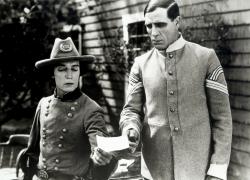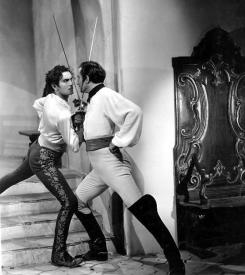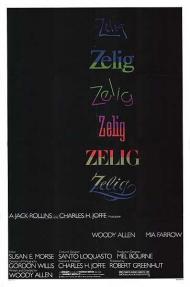



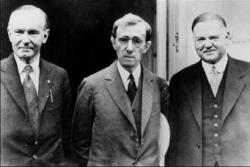
Zelig is a 1983 comedy from the mind of Woody Allen, shot in the mockumentary style. The bizarre story of one Leonard Zelig is told using a clever combination of interviews with leading intellectuals of the day like Susan Sontag and Saul Bellow, interspersed with archival footage, both real and recreated, and narrated by an unseen man. A full decade before digital technology would significantly simplify the process Allen, and cinematographer Gordon Willis, painstakingly inserted Zelig into existing vintage newsreel footage and historical photographs (see photo). They also filmed new scenes using 1920's technology to give them the right aged look. It took so long that Allen filmed both A Midsummer Night's Sex Comedy and Broadway Danny Rose while this film remained in production.
Zelig is a nondescript young man who exhibits the incredible habit of taking on the personalities and even physical traits of whomever he is around. At the beginning of the film this odd characteristic of Zelig's is first described by a quote from F. Scott Fitzgerald. At a society soiree on Long Island he observes Zelig declaring himself a Republican and speaking to the affluent guests in a refined accent. Later on, in the kitchen amongst the servants, Zelig adopts a cruder tone of voice while stating his loyalty to the Democrats.
As the story progresses Zelig's changes become more and more extreme. He becomes black around a black jazz band, and Chinese while working at a laundry. He soon gains notoriety by the public at large and is nicknamed “The Human Chameleon”. Songs are written about him and his story is told in a Hollywood movie. His fame brings him to the attention of a psychiatrist named Eudora Fletcher (Mia Farrow) who, believing his disorder to be psychological in origin, begins treating him. They eventually fall in love but not before Zelig has numerous adventures while rubbing shoulders with many famous people of the era.
Allen manages to insert his trademark one-liners into the story. While being treated by Dr. Fletcher, Zelig, true to form, assumes the personality of a doctor. During a session he tells her, “I have an interesting case. I'm treating two sets of Siamese twins with split personalities. I'm getting paid by eight people.” Eventually Zelig's antics catch up to him as he leaves in his wake a string of personal disasters. In one scene he is heard making this statement over the radio, “My deepest apology goes to the Trochman family in Detroit. I...I never delivered a baby before in my life, and I... I just thought that ice tongs was the way to do it.”
Allen cleverly satirizes conformity by taking it to such an extreme level. Zelig so wants to be accepted and liked that he buries his true personality while adopting the beliefs and tastes of whatever group he is around. You can have fun thinking about the serious implications of this character or simply enjoy the movie for its sly humor and very creative format.
I first saw this movie with my brothers in 1983. At sixteen I didn't completely get it. I hadn't watched it since then and I must say that I was pleasantly surprised at just how much I enjoyed it this time around. It is one of Woody Allen's most original stories and it seems to have gotten better with age. Or perhaps it is only my ability to fully appreciate it that has grown over time. Either way Zelig is fascinating and often hilarious.