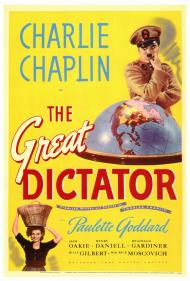



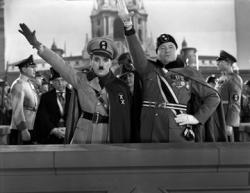
Thirteen years after The Jazz Singer ushered in the sound era Charlie Chaplin's first all-talking movie premiered. The Great Dictator satirized Hitler and Nazi Germany with Chaplin playing dual roles. He's an unnamed Jewish barber, who looks suspiciously similar to the Little Tramp, as well as Adenoid Hynkel, dictator of Tomania, who looks intentionally similar to Adolph Hitler, who wore a mustache similar to the most famous silent comic in movie history.
This roundabout of identities reaches its climax during the movie's final scene where Chaplin looks directly into the camera and delivers a heavy-handed speech about freedom and man's inhumanity to man. Here you have Charles Chaplin, in the guise of the Little Tramp, playing a Jewish barber, posing as Adenoid Hynkel, spoofing Adolph Hitler. It's just too bad this final speech turns the movie into a lecture and in so doing stops the comedy dead in its tracks.
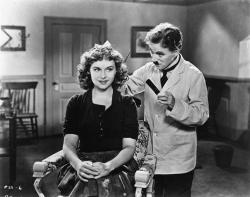
It begins during the First World War. Chaplin's unnamed protagonist saves the life of a pilot named Schultz by flying him (upside down) to safety. Although they both survive the crash landing, Chaplin's character develops amnesia. The story then jumps ahead 20 years. Having finally regained his memory this man is released from the hospital and goes to live in a Jewish ghetto where he works as a barber. The story alternates between his life and scenes of the titular dictator as he plans his attack on the neighboring country of Osterlich (think Austria). There is of course a girl (Paulette Goddard) along the way as the story inevitably leads to the two Chaplin characters being mistaken for each other and subsequently switching places.
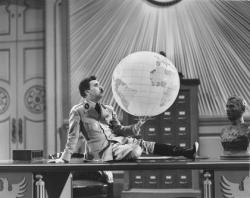
There are moments of comic brilliance in The Great Dictator. Chaplin speaking a nonsensical German language that ends in coughing sounds while he gesticulates in an exaggerated manner is worthy of a few chuckles. And then there is the gracefully comic balloon ballet where the world is -literally- his plaything. It is easily the most famous scene in the movie and is perhaps the most sublime bit of pantomime ever committed to film. The Jewish barber looks like a slightly older, and a decidedly better dressed, version of the Little Tramp. At 50 this would be the last time Charlie Chaplin would ever don the familiar costume, but when he opens his mouth to speak the illusion is shattered.
Jack Oakie provides laughs as the visiting ruler Benzino Napaloni of Bacteria (an equally broad parody of Benito Mussolini). His arrival by train, accompanied by his wife, is a comic highlight. Watching these two ridiculous dictators engage in a contest of one-upsmanship is quite humorous but Chaplin's scripted jokes aren't nearly as funny as his silent gags. And the look of the sets coupled with Chaplin's unchanged camera style would have made the movie seem already outdated in 1940.
Despite these flaws The Great Dictator was a huge hit in its day, both critically and commercially. It received five Oscar nominations (but zero wins) for Picture, Actor (Chaplin), Supporting Actor (Oakie), Original Screenplay, and Original Score. It grossed five million dollars at the domestic box office making it the most financially successful movie of Chaplin's entire 50+ year career. At a time when the powers that be in Hollywood were afraid of directly insulting Hilter's Germany, Charles Chaplin put his own money on the line in order to do so; proving he wasn't just a funny filmmaker but also a courageous one.