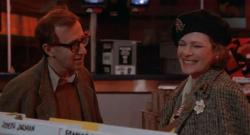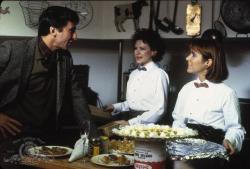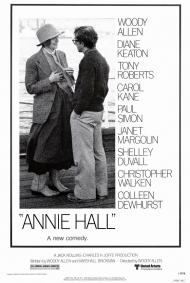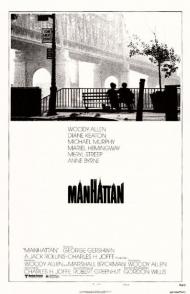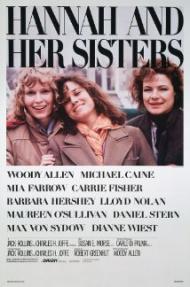



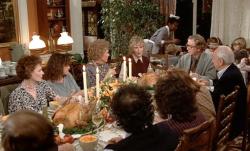
Hannah and Her Sisters stands alongside Annie Hall and Manhattan as one of Woody Allen's most successful and critically acclaimed movies. All 3 are cinematic love poems to the city of New York as well as being intelligent, often hilarious, stories about human relationships. Hannah grossed over 40 million dollars in 1986 and was nominated for 7 Academy Awards including Picture and Director. It took home 3 Oscars, one for Allen for Original Screenplay, and Supporting Actor and Supporting Actress for Michael Caine and Dianne Wiest.
The movie covers 3 Thanksgivings in the life of a New York City family. Hannah (Mia Farrow) has 2 sisters, Lee (Barbara Hershey) and Holly (Dianne Wiest). Hannah's husband Elliot (Michael Caine) secretly lusts after Lee, while Holly is unlucky in love and goes from job to job, unsure what to do with her life. Hannah provides emotional as well as financial support to her siblings. Lee is at the end of a relationship with an older reclusive cynic played by Max von Sydow. Allen, in a somewhat peripheral story, plays Hannah's hypochondriac ex-husband Mickey. Over the course of the movie he endures a health scare followed by an existential crisis where he explores both Catholicism and Krishna Consciousness.
Allen's love affair with Manhattan is front and center. In one scene he has an architect (Sam Waterston) show Holly and her friend April (Carrie Fisher) some of his favorite buildings around the city. Woody makes dirty, graffiti covered 1980's Manhattan seem as romantic as April in Paris.
There are several scenes that stand out. One shows the sisters sitting around a table talking. As they converse the camera rotates around them passing the backs of their heads as it goes. It's an obviously artistic flourish, unlike Allen's usual straightforward camera work. Another brilliant moment happens when Allen's character leaves his doctor's office having learned he does not have a brain tumor. He is completely joyous and skips down the sidewalk, but in typical Allen fashion his celebration is short-lived. By the time he gets to the end of the block his body language tells us he is already back to his old pessimistic self.
The supporting cast features Farrow's real life mother Maureen O'Sullivan (Jane to Johnny Weissmuller's Tarzan) as Hannah's "boozy old flirt" of a mother. Lloyd Nolan, in his final movie role, plays Hannah's father. Their scenes together around the piano are both touching and funny. The fact that Woody used Mia Farrow's actual apartment, and her real life mother, adds an extral layer of veracity. Even Farrow's adopted children appear as extras, including Allen's future wife Soon-Yi Previn.
Allen writes such great dialogue that I had to include a few quotes. Nobody combines intellectual and lowbrow humor like Woody Allen. Take this speech by Allen's character Mickey. “And Nietzsche, with his theory of eternal recurrence. He said that the life we lived we're gonna live over again the exact same way for eternity. Great. That means I'll have to sit through the Ice Capades again.”
Mickey's a writer for television, here's an exchange he has with his producer Ed (J.T. Walsh)
Mickey: Why all of a sudden is the sketch dirty?
Ed: Child molestation is a touchy subject, and the affiliates...
Mickey: Read the papers, half the country's doing it!
ED: Yes, but you name names.
Mickey: We never-we don't name names, we say "The Pope"!
Max von Sydow as Frederick gets this juicy speech about watching television. “You see the whole culture. Nazis, deodorant salesmen, wrestlers, beauty contests, a talk show. Can you imagine the level of a mind that watches wrestling? But the worst are the fundamentalist preachers. Third grade con men telling the poor suckers that watch them that they speak with Jesus, and to please send in money. Money, money, money! If Jesus came back and saw what's going on in his name, he'd never stop throwing up.” An ironic last line when you remember that Sydow played Jesus in The Greatest Story Ever Told.
Hannah and Her Sisters ends on an upbeat note. Mickey recalls the moment he nearly committed suicide but instead went to see a Marx Brothers' movie. He finally comes to terms with his existential crisis and offers this pithy advice, “What if there is no God and you only go around once and that's it. Well, ya know, don't you wanna be part of the experience? You know, what the hell it's not all a drag. And I'm thinking to myself, Jeez, I should stop ruining my life searching for answers I'm never gonna get, and just enjoy it while it lasts.”
That's how I feel whenever I watch Annie Hall, Manhattan, or Hannah and Her Sisters.