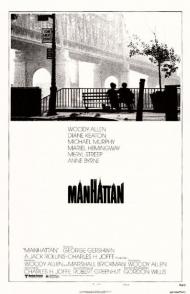



Although so many of Woody Allen's movies are set in New York City, it is in Manhattan where he really wears his love for his hometown on his sleeve. The first five minutes are a Valentine to the city, featuring a romantic montage of images, shot in black and white, accompanied by Gershwin's "Rhapsody in Blue" and narrated by Allen himself, culminating with fireworks and the line, "New York was his town, and it always would be". For anyone who loves New York, this is one of the greatest movie openings of all time.
Clearly Allen has a romantic opinion of the city that is on full display here. Lovingly shot in black and white, he goes to great pains to make Manhattan look like a wonderful place to live. Given that it was shot in the late 1970s, before the city had become the gentrified place that it is today, and was perhaps thought more of as the city of Taxi Driver and Midnight Cowboy by the rest of the country, this must have been more remarkable at the time. Of course, while Allen captures a moment in time, it really isn't a moment in time of all New York City, but just of a certain type of New Yorker; the Upper East Side intellectual.
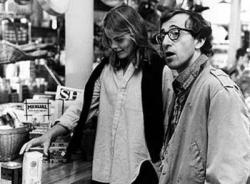
Allen stars as Isaac, a television writer who, when the movie opens, is having a casual affair with Tracy, a 17 year old girl played by Mariel Hemingway, who was nominated for an Oscar for her role. Given Allen's later love life and the public's changing attitudes since the more liberal 1970s, this plot point looms larger now than it did at the time. Isaac treats the relationship casually, while Tracy seems to be truly in love with him.
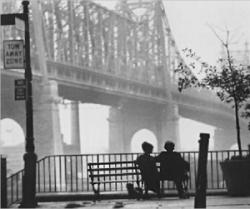
When Isaac's married friend, Yale, introduces him to his mistress, Mary (Keaton), Isaac is at first annoyed by her cultural snobbery, but after spending one memorable night talking and walking around the city, culminating in the film's most iconic scene of the two of them sitting on a bench in the shadow of the Queensboro bridge, Isaac finds himself in love with her. He breaks it off with Tracy after Mary is dumped by Yale and the two end up practically living together.
There are some minor subplots as well. One involves a surprisingly beautiful, young Meryl Streep as one of Isaac's ex-wives who is now a lesbian and is writing a tell-all book about their marriage. Another is Isaac quitting his television writing to become a novelist.
While this is definitely a comedy, this is a much more mature Allen than his earlier work. It's light years away from his early comedy and even compared to Annie Hall, the number of one-liners is vastly reduced. While there are more typical Allen lines, such as, "I can't express anger. That's one of the problems I have. I grow a tumor instead," his humor also includes more obscure jokes like, "When it comes to relationships with women, I'm the winner of the August Strindberg Award." where you need to know that Strindberg was a misogynistic, Swedish playwright in the late 1800s, to get the joke. Allen's stock neurotic character is toned down and he seems much less of a caricature, delivering one of the better acting performances of his career.
The problem with this movie is that no one in it is all that likable. Isaac is funny, but not exactly warm or fuzzy. Mary and Isaac's friends are pretentious and annoying at times. Only Tracy is shown as warm and sympathetic. And the big romantic moment at the end isn't really with a relationship that you want to see succeed.
Along with the typical Allen humor, the real joy is seeing such a loving view of New York City so perfectly captured on film. The carriage ride through Central Park, the crowded Elaines, Zabars, the Planitarium, Gramercy Park and dozens of other New York icons are littered throughout the movie as a constant background to the slim plot. As Isaac says at one point, "Boy, this is really a great city, I don't care what anybody says it's really a knock-out, you know?"