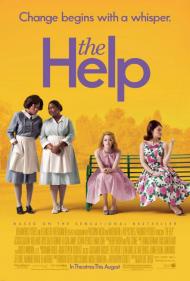




The Help could have been an insightful look at the intricate state of race relations between rich, southern white women and their black servants in Jackson, MS in the 1960s. Instead of being insightful, the filmmakers paint their story with the broadest possible strokes in distinct black and white, good and bad, right and wrong. The heroes of the story are mostly saintly, while the villain is a cartoon caricature. It has all the subtlety of a baseball bat to the head with the phrase, "Racism is wrong" written on it.
I say intricate race relations, because you have on the one hand, a group of women who felt themselves superior racially, and yet entrusted these "inferior" women with the raising of their children. You have the maids, who are paid employees, but also part of the family to an extent, at least to the children they raise. Many of these women probably spend more time with their maid than they do with their husband every day.
Current "It" girl Emma Stone plays Skeeter, a wannabe journalist, newly graduated from college, who returns to her hometown of Jackson, MS. She needs some experience and a story to garner attention to land a job in New York City. She sees her opportunity in the black maids of Jackson. She decides to tell their story, from their point-of-view. To that end she enlists the help of Aibileen (Viola Davis), the maid of a friend of Skeeter's. Aibileen recruits her friend Minny and the two of them recruit more maids.
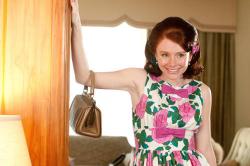
The villain of the piece is Hilly, played by Bryce Dallas Howard. She starts a movement to try and pass a law that states all homes with black servants must install a separate a bathroom for the help so that the white people won't pick up black diseases. She rules the young women in town, telling them how to behave and who is in and who is out.
Some of the things presented as Hilly's racism are a bit dubious however. At one point Hilly's new maid asks her for a loan of $75 and Hilly turns her down. True, she does it in a condescending manner, but when is it appropriate to ask your boss for a loan, no matter how noble the cause? Later the maid finds a ring behind Hilly's sofa, which she steals and pawns, which Hilly reports to the police and the maid is arrested. While the police are overly rough when they arrest her, I have to side with Hilly on this one. The maid broke the law, but her act is presented sympathetically and Hilly's villainously. Just because she was going to use the money to send her sons to college, doesn't make it any less wrong.
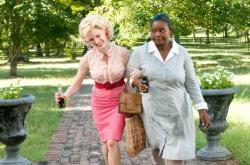
While Hilly and the writing of the book are the main plot devices, I found one subplot to be the most interesting. Minnie, as played by a scene-stealing Octavia Spencer, is fired by Hilly for using the master bathroom and Hilly gets her black-balled so that no one in town will hire her. She ends up working for the newly arrived Celia, whom Hilly and her group consider white trash. Celia is the hot as hell, but not too bright, new bride of a rich young local who the women think has married beneath him. She hires Minnie because she needs help learning how to cook and tend house. She treats Celia like a person and Minnie ands up helping her in return.
The cast in general does a good job, with Viola Davis being one of the dramatic standouts. She maintains a stoic facade and yet delivers a nuanced performance. I wouldn't be surprised to hear her name batted around in the supporting actress category when awards season starts.
At two plus hours, the movie runs long. There's a subplot with Skeeter going on a date and developing a relationship that could have been cut completely. I'm assuming it's there to either stay true to the book or to give Emma Stone more to do, but in any case it's not needed.
There's an old fashioned feel to The Help and not just in the setting, but in the filmmaking style as well. It's entertaining enough, but some shades of grey and added nuance would have given it more depth.