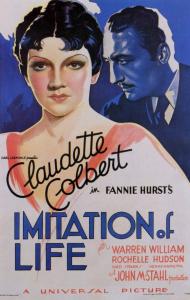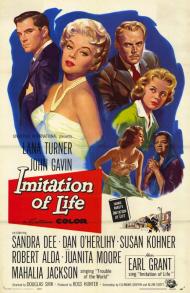


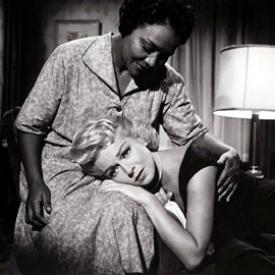
Twenty-five years after the original black & white movie version of Fannie Hurst's novel, director Douglas Sirk updated Imitation of Life with this glossy Technicolor production. This would be his last Hollywood movie. The general plot remains the same but many of the details, such as all of the main characters' names, have been changed. Gone is the dated pancake company. Instead the Lana Turner character, Lora Meredith, is an aspiring actress who eventually becomes a big star on Broadway. The rest of the story is unchanged: struggling white actress and recently widowed Lora and her young daughter meet widowed black Annie Johnson and her young white-looking daughter and their lives become forever entwined. This time the meeting takes place under the boardwalk on Coney Island sometime after the Second World War and covers the years up to the late fifties.
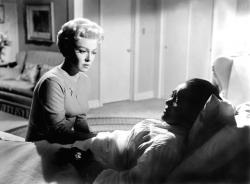
Unlike Claudette Colbert in the original version, Lana Turner's Lora is portrayed as a neglectful ambitious mother. She has little time for her daughter and takes her maid Annie completely for granted. In one scene she even expresses surprise that Annie would have friends and a life outside of Lora's household. During Annie's death scene Lora goes into hysterics, but is it because she truly loved Annie as a person or is she simply frightened at losing her? Douglas Sirk takes a much more cynical view of American society than the original movie did. The result is a less subtle but more emotionally powerful movie.
Juanita Moore is quite moving as the heartbroken and hard-working Annie, disowned by her only child because of her skin color. Lana Turner is also good. But in my book it is Susan Kohner, as the tormented Sarah Jane, who walks away with the movie. She is one of the most unhappy characters you will ever find in a movie. Her every word drips with bitterness and self-pity. In one memorable scene she takes a tray of refreshments in to Lora and her guests. She carries the tray on her head and puts on an affected Southern Negro accent. 'Fetched y'all up a mess 'a crawdads, Miss Lora...fo' you an' yo' friends!' An embarrassed Lora responds, 'Well, that's quite a trick, Sarah Jane...where did you learn it?' 'Oh, 'tain't no trick ta' totin', Miss Lora! I learned it from my mammy, an' she learned it from ol' massa, 'fo' she belonged to you.'
But it is the final scene that will cause projectile tears to spring from the eyes of any living being with a soul. Annie leaves Lora a detailed list of what she wants for her funeral. She wants the service at St. Patrick's Cathedral with her body to be carried in a coach up 5th Avenue, led by four white horses and a marching band. Mahalia Jackson appears as a choir soloist and sings a haunting version of 'Trouble of the World'. As they are carrying the casket out through the throngs of people lining the street, Sarah Jane pushes her way through the crowd yelling, 'Let me through, that's my mother!' She rushes up to the coffin and hysterically begs her mother's forgiveness.
Douglas Sirk certainly knew how to elicit an emotional response from his audience. Fannie Hurst deserves credit for creating these classic characters and Frank Skinner for composing a melodramatic score that would have made the great Max Steiner proud. The critically acclaimed Far from Heaven was clearly influenced by this movie and by Sirk's cinematic style in general. My one small complaint is that the first thirty minutes drag a bit, but once the girls grow up this movie is flawless right up to the final moment.