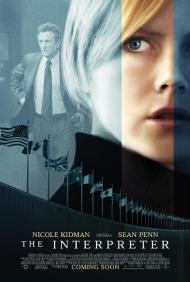




Sydney Pollack may be 70 years old, but he isn't slowing down. His The Interpreter is a fast-paced, tense thriller that also features some top-notch acting from its leads, Nicole Kidman and Sean Penn.
Kidman plays Silvia Broome, a United Nations interpreter who, late one night, overhears an assassination threat against Zuwanie, a controversial African leader, who is coming to speak at the UN, the following week. Penn portrays Tobin Keller, a Secret Service agent charged with the protection of foreign dignitaries. He is assigned to Silvia's case after she reports what she heard, but not to protect her, as she assumes, but to investigate her.
The plot thickens when Keller learns that Silvia is from the same African country as Zuwanie, and that she may still have connections with the rebels there. He doesn't know whether or not she is telling the truth about what she heard. Of course, we the audience know she is because the moment she overhears the threat is shown on camera. It might have been interesting if it hadn't been, so that we too would have to wonder.
With only a few days until Zuwanie's arrival, the clock is ticking for Keller and his team to track down the would-be assassins. Among the suspects is an African exile living in Brooklyn. In one of the movie's best scenes, three of Keller's biggest suspects all converge on one bus with explosive results.
While you might expect action and thrills from a political thriller, with this one, you also get great acting. Penn, one of the greatest actors working today, takes his clichéd character (the no-nonsense law enforcement officer with a troubled past) and makes him admirably human. And although Penn is outspoken about his political beliefs in real life, he is never allowed to bring them into this movie. Kidman is equally good, conveying mystery and terror, often at the same time. Even the supporting cast is populated with good actors, with most, no matter how small the part, being given enough personality to bring them to life, rather than just being the two-dimensional cardboard cutouts that we're used to in the backgrounds of movies like this one.
Pollack gives the movie an edge by creating a sense of urgency that is carried throughout most of the film. He also makes good use of the real United Nations, being the first filmmaker to ever be allowed to shoot a movie inside the building. If this is going to be the last movie he directs, at least he'll go out with a good one.
A sure sign of a good thriller is when the outcome is kept unknown. If you know how it's going to end, there are no thrills. I can honestly say that with The Interpreter, I didn't know the ending. I had my guesses, but it wasn't until the final climactic moments that I knew whether I was right or not. In a time when most movies broadcast their endings from the moment the lights go down, that's a rarity, indeed.