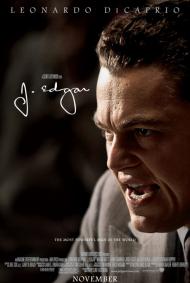



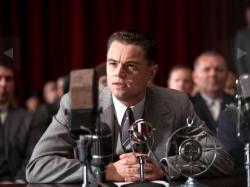
J. Edgar Hoover was a contradictory figure. On the one hand, he created an efficient crime fighting organization and helped to modernize policing, overseeing an FBI that solved many crimes and put away many well known criminals. On the other hand though, he was a megalomaniac who used and abused his department to keep himself in power for nearly 50 years. He was also someone who demanded impeccable standards of behavior from his agents, but yet lived a lie with reports of his closeted homosexuality and transvestism. Making a movie that fully captures this complex man is certainly a challenge for any filmmakers. Director Eastwood, star DiCaprio and writer Dustin Lance Black do their best and the result is a fascinating look at an interesting character, but the film itself is flawed.
Hoover's story is told in two intercut time periods. We see him in the 1960s through the early 1970s, but there are also flashbacks to the 1920s and 30s as we see the birth of the FBI. These flashbacks take the form of Hoover telling his story to a string of young FBI agents who are writing the "official" history of the Bureau. What's interesting about this method of telling the story is that in the past we're seeing Hoover's version of the story, and later we learn that not everything he's said was true. Other flashbacks take the form of Hoover's personal memories and it's in these moments that we learn the personal details of Hoover's life.
According to this film, there were three people of lasting importance in Hoover's life.
First and foremost was his mother, played here by Judi Dench. A religious woman who doted and dominated her son. You'll lose count how many times you hear Edgar say, "Yes, Mother." It is partly because of her hold over him that Edgar is never able to find personal happiness. At one point, in so many words, she tells him that she'd rather have a dead son than a gay one.
Second, was Helen Gandy, portrayed by an under-used Naomi Watts, his personal secretary of 54 years. They begin their relationship on a few dates, but the fact that Edgar's idea of a date spot is the library of congress, is a good indicator of where their relationship is headed. Following her rejection of him, their relationship becomes strictly professional, but given how long they worked together and how much he trusted her, I have to think that this movie skims over how deep their feelings must have been for each other. I don't mean romantically, but Edgar trusted her in a way that he trusted no one else.
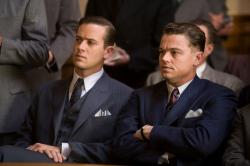
The third figure that dominated Edgar's life was Clyde Tolson, Edgar's right hand man and unconsummated (according to this movie) love of his life. There's an instant attraction between Clyde and Edgar and they come close on at least one of occasion of making their relationship physical, but Edgar can not bring himself to go against his upbringing.
DiCaprio delivers another Oscar worthy performance in the lead role. He plays Edgar at different ages and plays it convincingly at both. This is an egotistical, arrogant and deeply insecure and paranoid man and DiCaprio delivers a multi-layered performance that is sure to feel the love at awards time. He so dominates this movie that it's really a one man show.
Of the supporting cast, Dench is best. Her relationship with DiCaprio is both loving and creepy at the same time. As I said, Watts is under used and her relationship as Helen with Edgar, is never as fully explored as it could have been. Armie Hammer has the most important supporting role and is the most disappointing member of the cast. He makes a very unconvincing old man and in his most dramatic scene, DiCaprio acts circles around him.
The constant cutting between the time periods is interesting but doesn't necessarily add anything to the story that telling it in chronological order wouldn't have done. I also have my usual complaint that the movie runs too long. It's well over two hours and there's plenty of room for editing and tightening.
A complex man doesn't necessarily need a complex story, in fact, I might argue that with such a complex character, the simplest method of telling his story might be the best one. In any case, this is a great performance inside just a good movie.