


One of the many things I enjoy about watching movies is when you learn something about a time, a place or a famous person that you never knew anything about. With The Last Station I learned a thing or two about Leo Tolstoy; someone whom I knew nothing about beyond that he was Russian and wrote War and Peace amongst other novels. He seems, as presented here anyway, as a very interesting character. In fact he seems more interesting as a person than this movie does as a whole.
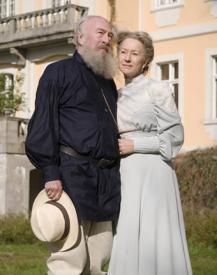
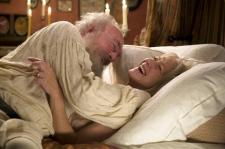
Christopher Plummer stars as the famous author and Helen Mirren plays his wife. Together they make a formidable acting pair and the two of them get to chew up the scenery together. In some ways I was reminded of Peter O'Toole and Katherine Hepburn in The Lion in Winter. You have an aging married couple who are sparring back and forth played by two actors of immense talent. Where this movie differs vastly from The Lion in Winter is in the writing. Where The Lion in Winter cuts deeply with sharp daggers of dialogue, The Last Station merely scratches the skin with blunted weapons that do no real damage.
The story takes place at the end of Leo Tolstoy's life. After being a celebrated author Tolstoy now has a following that is almost religious in nature. Chertkov, the leader of his following, wants Tolstoy to leave the copyright to all his work to his group so that the money can (in his words) benefit all mankind. Just how this would be executed and who exactly it would gain beyond Chertkov is not really explained. On the other hand you've got Tolstoy's wife, the Countess, who wants to ensure that her children's legacy is left intact by making sure the rights to her husband's work remains in the family.
Tolstoy is shown to be a bit of a contradiction. He sounds as though he led an interesting life as a young man and was rather wild in his way. He's also quite rich when the movie takes place and he lives quite well in pre-communist Russia. And yet he writes about and speaks about opposing private property and equality for all. It doesn't stop him from employing servants, but he talks about it a lot. When and why he started feeling that way isn't explained. And just why Chertkov has such a sway over him isn't revealed either.
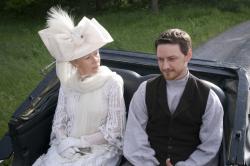
Certainly the best scenes in the film are those featuring Plummer and Mirren together. Both have been nominated for Oscars for their performance here and deservedly so. Mirren is especially good as the overly dramatic wife. Together they both make the material better than it has a right to be. James McAvoy is likable enough as Tolstoy's private secretary from whom the story is ostensibly, if not exclusively, told, but this is Plummer and Mirren's film.
I learned from watching this movie that Tolstoy was indeed an interesting figure and a great movie could probably be made about his life. While this is a good movie, thanks mainly to its leads, it's not a great one. With a better written script filled with sharper dialogue it might have been, but that's just not the case.