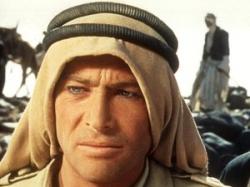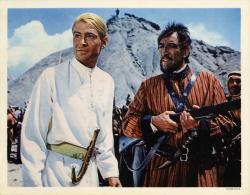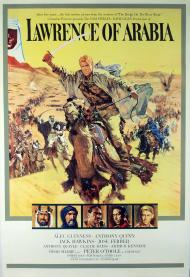



Lawrence of Arabia was the reason film was invented. It is the definition of everything that makes a movie great. It has a fascinating central character on a story of discovery and political intrigue. It is set in a rough, exotic locale. It is a history lesson of a part of the world that continues to make political news today. It has action and sweeping adventure. Oh, and lest I forget, it has some of the greatest film direction ever committed.
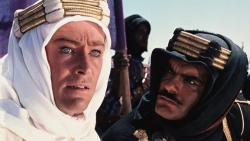
Based on his own writings, Lawrence of Arabia tells the story of T. E. Lawrence and his time spent in Arabia. The film opens with his death and then flashes back to him as an intelligence officer in Cairo in 1916. He is given an assignment to journey into the desert and check on the progress of the Arab revolt against the Turks. He is first introduced to this new harsh world when his guide is shot and killed for using a well that belongs to another tribe. This is the arrival of Omar Sharif as Sherif Ali. They create an allegiance that required quite a bit of understanding on both of their parts.
With the help of Sherif Ali, Lawrence organizes an Arab guerilla army that is not used to airplane attacks or tanks. Being that this was during World War I, Lawrence leads the Arabs in raids against the Turks. This mostly involves blowing up trains and attacking the enemy while riding on camels. He eventually becomes a valuable asset to the British army and a hero to the revolting Arabs.
Lawrence of Arabia is filled with moments that will stay with you for as long as you have a memory. Just after getting the news that he is going into the desert, Lawrence blows out a match. The scene suddenly changes to the sun rising over a desert landscape. I regret that I have never seen this movie on the big screen. Another great scene involves Lawrence killing a man in his group. I will not give details but it is a powerful moment.
One scene in particular was very scandalous but important enough to the plot that it had to be filmed. After getting abducted by some Turks, Lawrence is taken to a leader, who makes it clear that he has sexual interest in Lawrence. Made in 1962, David Lean had to be careful how he filmed it. In real life T. E. Lawrence described, in writing, how the sexual assault played out. After the Turk started to grope him, Lawrence kneed him. He then beat Lawrence and sent him away with his guards to be beat more. He wrote about how they would take turns beating him and in between beatings, "...play unspeakably with me." The most fascinating thing about this incident is that Lawrence wrote that nearing the end of the beating he felt a, “...delicious warmth, probably sexual, swelling through me...” Lawrence, also through his writings, admitted that he was a virgin. Thus his first sexual experience was quite horrendous.
This event, is critical to the film in that it changes how Lawrence looks at the world. Just before it happened, he saw himself as a romantic hero to the Arab who chanted his name after a victory. The sexual assault brought his ego back down to Earth. In real life this event lead to much speculation that Lawrence was a homosexual and/or a masochist. David Lean includes a scene early in the film that may support this. Lawrence puts a match out with his fingers. Another officer asks him to tell him the tricks secret. Lawrence responds, "The trick is not minding that it hurts."
Another interesting aspect is that the only women in the film are extras. No female has even a single line of dialogue. My personal gripe is the casting of the Caucasian Alec Guinness as an Arab. If perhaps he was not so famous it would not have mattered so much, but as I know what Guinness actually looks like, it seemed almost a joke to put him under make up and a false nose.
Even with its blemishes, the magnitude and scope of this film is not to be ignored. The exteriors, filmed in Spain and Jordan are breath taking. Filming alone took over a years time. It won the Academy Award for best cinematography and David Lean won his second consecutive Best Director Oscar. Lawrence of Arabia even won for best Editing, which is quite an accomplishment for a nearly four hour film.
Yes, Lawrence of Arabia is a long film, but it is more than just a movie. It is a cinematic masterpiece. It is a piece of art that dazzles your eyes, raises your pulse and leaves you thinking. Even at the end of this epic story, I wanted more. What was next for Lawrence? I looked him up as this film sparked my interest in him. He truly was a man of his time, but one that still fascinates one hundred years later.