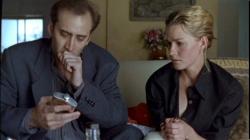




If Hollywood love stories have taught us anything, it's that there's someone for everyone, even the two lost souls featured in Leaving Las Vegas. This romantic tragedy is a dark story about two people who find each other on the road to oblivion. It's not a happy tale by any means, but it is a moving one that is beautifully acted by its two leads. It generated a large amount of buzz when it was released, along with several award nominations and wins. Almost 20 years later and it still holds up remarkably well.
Nicolas Cage stars as Ben Sanderson, an alcoholic screenwriter who loses his job at the beginning of the film. His background is never fully explained. We know that at some point he had a wife and child, but whether he started drinking because he lost them or he lost them when he started drinking, isn't really important. He's an unhappy drunk, who decides to burn or throwaway his possessions and take his severance check to Las Vegas and literally drink himself to death.
Once in Vegas he runs into Sera, a prostitute played by Elisabeth Shue. Sera is as lost as Ben is. She's in a relationship with an abusive pimp. Her sense of worth is so warped that when her pimp cuts her as punishment and then feels remorse, she feels bad for him.
These two damaged, train wrecks are able to find some kind of solace in each other, although perhaps not equally. For Ben, Sera is someone to have fun with and to help take care of him, although never have sex with, since the only thing he truly desires is in a bottle. He makes Sera promise that she will never ask him to stop drinking. At first Sera seems attracted to Ben like someone picking up a stray puppy. Clearly she only feels she has worth when she's giving something, most often her body. She continually attempts to get Ben to have sex with her, partly because she hopes to make a deeper connection with him, but also because you can see that this is how she's used to doing things. But perhaps the fact that Ben doesn't want to have sex with her, but still wants to be with her, is what she finds so attractive about him in the first place. The tone of the film is set from the beginning however, and you know that these two aren't going to live happily ever after together.
Although nowadays Cage is known for appearing in whatever b-movie will provide him with a paycheck, he was taken seriously as an actor once upon time. He won the Academy Award and a slew of other awards for this part. Given the subject matter and the tone of the film, his win seems almost an anomaly. Not because he isn't' good, but because this movie isn't typical Oscar fare. It feels more like an independent film, more likely to win a Spirit Award than an Oscar. Reportedly he prepared for the role by binge drinking and having friends film him while drunk so he could mimic his behavior. It's an effective technique and one that is far from the stereotypical drunk that is usually shown onscreen.
As good as Cage is though, it is Shue who is the revelation. We learn even less about Sera's background than we do about Ben's, but because of Shue's heartfelt performance we know all that we need to know about her. She displays a range of emotion as she is put through the wringer. If there's any hope in this dark film, it comes from her. There are scenes scattered throughout its length where she seems to be telling this story in the past tense, to possibly a psychiatrist. In terms of acclaim, this was the height of Shue's career, earning an Oscar nomination, but not a win. She continues to work, but has yet to top this film.
Helping to set the tone of the film is a moody, jazzy soundtrack composed by the film's director, Mike Figgis. It adds greatly to the atmosphere, as do the standards sung by Sting and Don Henley.
This isn't a traditional love story. Instead of romance you have two of life's losers clinging to each other as they head down the drain. It's a gloomy film, but a riveting one.