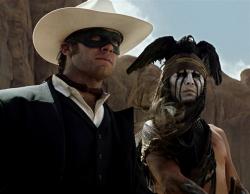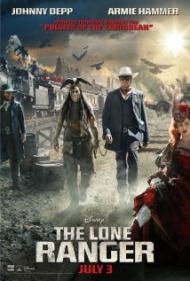



I've often complained about the length of movies these days, but none in recent memory have been so worthy of that particular criticism as The Lone Ranger. At 2 and a half hours, it is easily an hour too long. Its plot is a simple one that's straight out of the old b-movie westerns of the 1950s and Clayton Moore and Jay Silverheels could have wrapped the whole thing up in 30 minutes. It's not the movie's only problem, but it exacerbates all of the other ones.
Compounding the length problem is a framing device that serves no real purpose. The movie opens in 1933 with a small boy visiting a circus. In a tent devoted to the Wild West, he comes across a display of the Noble Savage that contains an aged Tonto (Depp in heavy makeup/CGI) who proceeds to tell the boy the story of the Lone Ranger. The film cuts back to old Tonto relating the tale from time to time, succeeding in lengthening the movie without adding anything to it.
As the story proper begins, John Reid is traveling by train back to his hometown in Texas. Like Jimmy Stewart in The Man Who Shot Liberty Vallance, he's a lawyer who thinks that he can serve justice better out of his law books than with a gun. Shortly after his arrival amid a gang attack and a derailed train, he rides out with his brother and a group of Texas Rangers after Butch Cavendish and his gang. Following an ambush all of the Rangers are left for dead, with only John surviving. He's rescued by Tonto, who is also seeking revenge on Cavendish, and who convinces John that he's better off wearing a mask to hide his true identity. This simple revenge tale is then stretched out with an uneven tone that meanders for another hour and a half beyond this point.
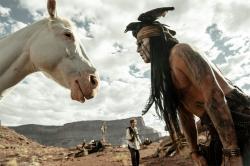
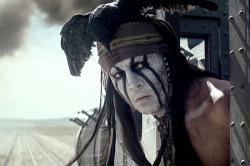
The film is directed by Gore Verbinski, who reportedly suggested Depp for the role of Tonto. While no one today would dream of putting on black face, apparently it's still okay to don red face. Depp hasn't helped matters by first claiming an unsupported Native American heritage and then saying things like, "I wanted to maybe give some hope to kids on the reservations. They're living without running water and seeing problems with drugs and booze. But I wanted to be able to show these kids, 'Fuck that! You're still warriors, man.'" Because apparently in Depp's mind, the best way to give young Native Americans hope is to show them a white man pretending to be one of them and then make condescending remarks about them.
Although I realize my review has sounded fairly harsh so far, I should hasten to add that there are some enjoyable aspects of this film. Depp makes some odd choices while playing Tonto, but he does provide some laughs. He and Armie Hammer share a good buddy relationship that keeps things light. The film is sandwiched at the beginning and end by two spectacular train wrecks. The finale seems to be paying tribute to Buster Keaton's The General, and although Depp is no Keaton, his antics are enjoyable. If only it didn't take so long to get to that finale.
There's also the occasionally uneven tone. Most of it is played lightly, but with a few darker moment thrown in, such as the eating of a human heart and the slaughter of an attacking Indian tribe. These moments never quite work as well as the comedic ones.
The biggest question surrounding this movie is why would Disney make it? Especially at the reported cost of $250 million. If there's a single movie genre that's truly dead, it's the Western. The only built-in audience is an aging one who might remember watching the television series some fifty or sixty years ago. And that audience isn't likely to be overly pleased by the slightly revisionist take on the story. Teenagers and kids today are unlikely to have even heard of the masked man and his faithful Indian sidekick. A smaller film would have seemed to be the smarter way to go.