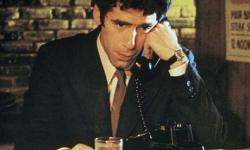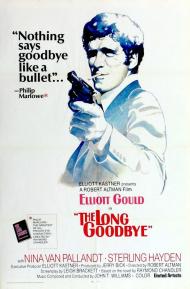



The Long Goodbye is Robert Altman's take on film noir as updated to the 1970s. It is based on the 1953 novel by Raymond Chandler, featuring his legendary fictional private eye Philip Marlowe. The screenplay was adapted by Leigh Brackett. 27 years earlier she co-wrote the screenplay for The Big Sleep, based on another Chandler novel in which Marlowe appeared. Instead of Humphrey Bogart we have Elliott Gould as the famous gumshoe.
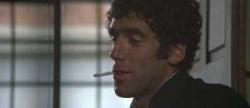
Altman said that he envisioned the story as if Marlowe had been asleep for 20 years and woke up in the 1970s. His behavior is out of step with the times. He drives a 1948 Lincoln Continental Convertible Cabriolet and chain smokes cigarettes, while none of the other characters in health conscious, sunny California are shown lighting up.
Gould's Marlowe is laid back and wisecracking but also a bit of a bumbler. He's an outsider looking in at the rest of the world. In what must surely rank as one of his finest performances Gould manages to be hip and fresh while also seeming like an anachronistic tough guy detective from the early 1950s.
The movie opens with a cute sequence where Marlowe wakes up in the middle of the night to feed his cat, only to discover he's out of cat food. He goes to an all night store but they are out of his cat's favorite food. He buys another brand and tries to fool his cat by putting the different brand in the favorite brand container. The cat, of course, doesn't fall for it and runs away. This was the same cat that would later become famous as the finicky Morris in those long running commercials.
Marlowe's neighbors are a group of young women that spend all their time on their balcony either scantily clad or naked, doing yoga and getting high. Robert Altman was a connoisseur of the female form and most of his movies include at least one naked woman. Whereas every male visitor to Marlowe's apartment cannot take their eyes off of his sexy neighbors, Marlowe himself seems oblivious to their presence.
Later that same night after the cat food incident, an old friend of Marlowe's shows up asking for a ride to Tijuana. Marlowe obliges him, not realizing that he has just gotten himself caught up in the middle of a murder mystery. This involves an older alcoholic Hemingway-esque writer (Sterling Hayden in a great performance), his much younger trophy wife (Nina Van Pallandt in another great performance), and a ruthless Jewish gangster (Mark Rydell making it three for three in the great performance category).
The story leads the viewer on a twisting road where things and people aren't who they seem to be. Altman films the proceedings with a constantly moving camera that tracks here and there and zooms in and out without ever seeming to get in the way of the story by drawing too much attention to itself. No director has ever done this better than Robert Altman.
Although the story is a serious murder mystery with one surprisingly violent scene, it also has a sense of humor. There is a Colony security guard who is friends with Marlowe and who does impressions of old time Hollywood stars like Cary Grant and Jimmy Stewart. His best impressions though are less expected. He does a great Walter Brennan as Stumpy in Rio Bravo complete with his exaggerated limp and a truly hilarious Barbara Stanwyck that goes like this, “I don't understand. I don't understand it at all. I've never understood it, Walter. I just don't understand why I don't understand it all.”
There are only two songs heard in the entire movie. One is “Hurray for Hollywood” and the other is the eponymous theme song written by John Williams and Johnny Mercer. One little detail that Robert Altman came up with was to include many various arrangements and recordings of the theme song that are incorporated throughout the movie. These include as a song on the radio, as supermarket muzak, as a hippie chant, as a dirge played at a funeral by a Mexican marching band, and even as the first notes of a doorbell chime.
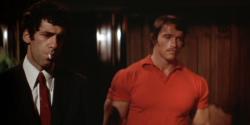
Look for Arnold Schwarzenegger and David Carradine in cameos. Schwarzenegger plays one of Mark Rydell's henchman and doesn't get a single line of dialogue. Carradine plays a philosophy spouting cellmate of Marlowe's in a scene where he goes to jail.
The final scene caused a bit of controversy among Raymond Chandler purists. I won't give it away but it departs from the way the novel ends and the morality of Philip Marlowe's behavior is called into question. I personally enjoyed the ending but then I've never read the book. The Long Goodbye is a forgotten gem in Robert Altman's legendary career and featuring Elliott Gould in what I think is his finest screen hour.