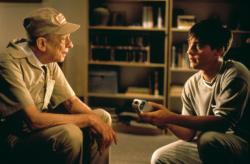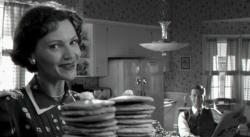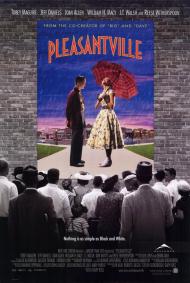



Pleasantville opens with a series of scenes where teachers are talking about how bad the world is. One talks about the poor economy. Another talks about global warming. Another gives a lecture on aids. David is a high school nerd, who likes nothing more than to watch reruns of his favorite old black and white television show, Pleasantville. It is one of those 1950's family shows like Leave it to Beaver or Father Knows Best, where life is simple and far more optimistic than his real life. He plans to watch an all night marathon, when his self admitted slutty sister, Jennifer, tries to steal the remote. She has a boy coming over to watch a concert. The remote gets broke and Don Knots shows up with one that sends them into Pleasantville.
The movie is now black and white as David and Jennifer are now the children on the television show. David is fascinated by it all as he recognizes every character. Jennifer is mystified by it all. He tries to explain, "They're happy like this." but Jennifer snaps back, "No, David. Nobody's happy in a poodle skirt and a sweater set." They go to school, because that is what the characters are supposed to do. Jennifer is not convinced. "We're supposed to be at home, David. We're supposed to be in color!"
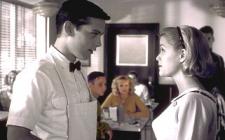
David fits right in. He even works his characters job at the soda shop. Jennifer is bored out of her mind until she discovers that the captain of the basketball team, Skip, likes her. "I don't know if I ever told you this before, but I think you're just about the keenest girl in the whole school!" He tells her. "Oh, really Skip? The keenest?" She responds. Whereas Skip was nervous to hold her hand, Jennifer introduces him to sex on their first date. After making out for awhile in his car, a perplexed Skip looks down at himself and says, "I think I might be ill. Something's happening to me." Jennifer responds, "That's supposed to happen."
Shortly after taking Jennifer home, Skip sees a red rose among the shades of his gray world. Skip tells the basketball team about sex, and before you know it, many teens are doing the deed and becoming colored. David meanwhile has encouraged his boss at the soda shop to pursue his dream of being a painter. He soon starts to see things in color. Jennifer discovers that all of the books in town are blank. She and David tell the teens what the books are about, causing the books to fill in. This results in more students turning into color after they read.
At this point in the movie I am all about the message of education being a path to freedom. The use of color as a metaphor for enlightenment is brilliant. The more people learn, the brighter the world around them becomes. If writer/director Gary Ross had stopped there I would have called this movie a masterpiece, but he had to take it one step further.
Almost all of the adult white males in town seem to be against things changing to color. They have book burnings. They are prejudiced against the people who have turned into color. David's television Dad is embarrassed by his wife having turned colored. He tells her to put makeup on it. The mayor gives a speech where he uses the word, "Right" many times. He tries to pass laws against the colors. What was a movie about discovering freedom through diversity becomes a liberal/conservative debate, with conservatism coming up short.
If Ross had wanted to be politically fair, he would have had at least one of the girls having sex become pregnant. They obviously did not have condoms in the town. In typical liberal fantasy, there are no repercussions for their actions. David’s TV mom has an affair on her husband, but acts like it is alright. The Soda Shop artist paints a nude picture of her on the window for all the town to see, and is then surprised when the town folk react shocked. As if they would respond any other way.
The best thing this movie says is that we all have to come to a point in our lives where we make a decision that sets us free. For some in the movie it is sex. For others it is discovering your passion in life. For David it was standing up for someone. For Jennifer it was saying no to sex and yes to an education. "I did the slut thing, David. It got kinda old." We all have to make decisions for ourselves if we want to grow and find true happiness, but responsibility comes with those choices. As this is a fairy tale, Ross chose to gloss over the responsibility aspect with a liberal twist. At the end of the movie it is not the wife who had an affair who has to apologize or admit guilt, but the conservative husband for taking her for granted?