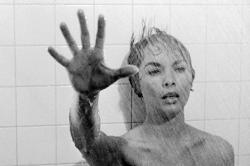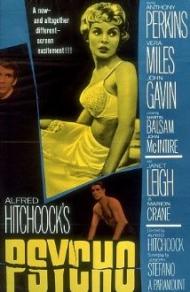



Alfred Hitchcock's Psycho is one of the most influential and iconic movies ever made. More than any other film, I think, it was the one that ushered in the 1960s. It's the mother of every slasher film ever made and Norman Bates is one of the most memorable villains ever to cast a tormented shadow across the silver screen. From the classic opening title sequence by Saul Bass to the final terrifying close-up of Anthony Perkins, Psycho offers a masterclass in suspense and horror. The infamous shower scene lasts just three minutes but it includes more than 50 cuts. Frame for frame it's arguably the most famous scene in movie history and Bernard Herrmann's screeching string-section score is equally unforgettable. During those three minutes American audiences lost their innocence. The Movies would never be the same.
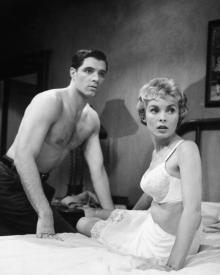
Janet Leigh plays Marion Crane, a working girl who absconds with $40,000 one Friday afternoon. Hitchcock directs with his usual concise inventiveness. Marion leaves the office on her way to the bank. We learn of her theft in the very next shot. The camera reveals the envelope stuffed with cash lying on a bed. Next we see Marion packing for a trip. As she makes her getaway she has nothing but bad luck. Her boss sees her driving even though she told him she didn't feel well and was going home to bed. Next she falls asleep in her car by the side of the road and draws the attention of a traffic cop. Her nervous behavior makes this policeman suspicious and he follows her. He witnesses her purchasing a new car and paying with cash but he lets her go. What lies ahead is much worse.
Today, of course, we all know Marion's fate. It's nearly impossible to see this movie for the first time without knowing about the shower scene. But imagine yourself in the audience in 1960. The point of Marion's bad luck is to distract the audience. By diverting their thoughts to Marion's crime and her odds of getting caught the audience has very little time to see the killer coming. And besides, who ever heard of the star of the movie dying in the first hour?
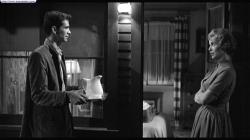
Janet Leigh is terrific as Marion Crane. Her wide-eyed expression of guilt is countered by a steely inner resolve. In her blind flight from the law she runs smack into something much more dangerous. The final shot of her eye in extreme close-up is brilliant. But as good as Leigh is, it's Tony Perkins who gives the most riveting performance. He's perfect as the unassuming young man with a dark, twisted secret. At first you feel sorry for this lonely, tortured soul. “A boy's best friend is his mother.” He tells Marion. At first Norman seems friendly enough but as the night progresses cracks begin to show in the mask he's wearing.
As groundbreaking as Psycho was it is also indebted to the past. It borrows horror movie tropes that had been established long before 1960. For example, Marion arrives at the Bates Motel at night during a thunderstorm. Lightning illuminates an ornate mansion looming on a hill just behind the motel. It's the classic “dark and stormy night” scenario. But Hitchcock turns the cliché on its head with the shower scene. It's very modern and brightly lit with an almost clinical eye. Nothing like it had existed on film before.
Psycho is the most famous movie the master of suspense made during his long and illustrious career. It came at the absolute peak of his success. It followed two other classics. He directed Vertigo in 1958, North by Northwest in 1959, and Psycho in 1960. What an amazing feat. Vertigo is more hauntingly artistic, North by Northwest is more purely entertaining, but for my money, Psycho is Alfred Hitchcock's greatest masterpiece.