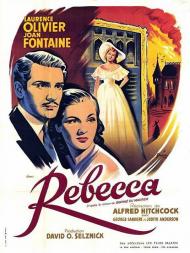



Of the many classic movies directed by Alfred Hitchcock during his forty years in Hollywood, only his debut film in Tinseltown, Rebecca, won the Best Picture Academy Award (for producer extraordinaire David O. Selznick). This screen adaptation of English author Daphne du Maurier's popular 1938 novel was a huge hit both commercially and critically. It earned an impressive eleven total Oscar nominations, including one for Hitch's direction and three of the four acting awards: Actor, Actress, and Supporting Actress for Olivier, Fontaine, and Anderson, respectively. Besides the big one its only other win was for B&W Cinematography (back in the days when they gave out separate awards for color movies) for George Barnes.
“Last night I dreamt I went to Manderley again.” Thus Hitchcock begins his film exactly as the book began. He would remain quite faithful to the written page, although he did add several artistic touches such as having it rain when the newlyweds arrive at Manderley, and he made changes to the character of Mrs Danvers, making her younger and being more vague about her background. Thanks to the censorship of the day one key detail concerning the climax was altered but I can't say what without giving too much away.
The opening line is spoken by a young woman known in the script only as The Second Mrs. de Winter. While in Monte Carlo working as the paid traveling companion of a matronly socialite our young heroine meets and is quickly courted by wealthy widower Maxim de Winter, in town to forget his wife Rebecca's recent drowning. She accepts his proposal of marriage and arrives at his palatial seaside estate completely unprepared for her new station in life. She is soon being tormented by the sinister housekeeper who has an odd obsession (that may or may not be sexual) with the memory of the First Mrs. de Winter. The housekeeper, Mrs. Danvers, goes on and on about how elegant and refined Maxim's first wife was while making disparaging comments about any alterations to the house the new bride suggests.
If you want to know what happens next in this excellent mystery/thriller by The Master, you'll have to watch it because I'm not giving any more of the plot away. I'd rather talk about the amazing cast. Actor for actor this just might be Hitch's best ensemble ever.
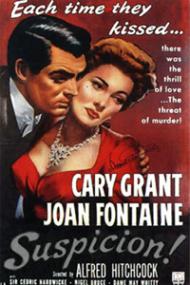
Joan Fontaine beat out many famous actresses for the lead role. At one point or another Carole Lombard, Maureen O'Hara, Vivien Leigh (whom Olivier was campaigning for), Anne Baxter, and Fontaine's big sister Olivia de Havilland either tested or were considered for the part. Fontaine didn't win the Oscar but did so the following year for her work (in what some called a consolation prize) in Hitch's similar but vastly inferior Suspicion. She gives the finest performance of her career as the young bride in over her head at Manderley.
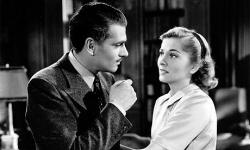
Laurence Olivier makes the perfect Maxim de Winter. He's charmingly sophisticated and incredibly manly at the same time, which is not an easy feat. He's a bit of a cipher at the beginning of the story but becomes a fully rounded character during the secret-revealing second half. He has better chemistry with Fontaine than Cary Grant would muster the following year in Suspicion.
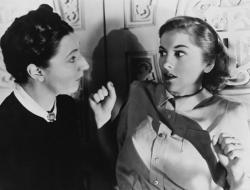
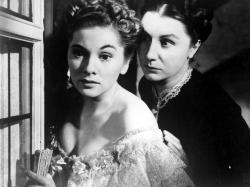
Judith Anderson, whom I always remember from her indelible performance as Big Momma in Cat On a Hot Tin Roof, is creepy as hell as Mrs. Danvers. She rarely blinks and is hardly ever shown walking. She just seems to appear suddenly in doorways. When she does move she almost seems to glide across the floor. In her best scene she tries to talk an upset Mrs. de Winter into committing suicide by jumping from a window to the rocky cliffs below (see photo).
George Sanders has a small but pivotal role. He played decadent snobs better than anyone as he demonstrates here. If you are familiar with his resonant speaking voice no doubt you can picture him uttering lines like, “You know, old boy, I have a strong feeling that before the day is out, somebody's going to make use of that rather expressive, though somewhat old-fashioned term ''foul play.''”
The supporting players include many stalwart talents of the era. Not many movies can boast the likes of Nigel Bruce, Reginald Denny, Gladys Cooper, C. Aubrey Smith, Leo G. Carroll, and Florence Bates. The result is that even the smallest parts in the movie are made memorable because of the actor portraying them.
Rebecca is a fabulous movie. Some may consider it a tad slow at times, it does clock in at just over the two hour mark, but it is vintage Hitchcock, a compelling mysterious romantic thriller done in his inimitable (though many have tried) style.