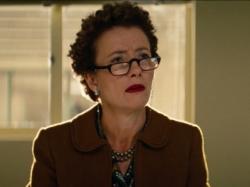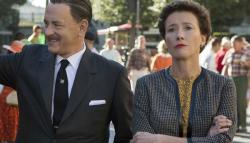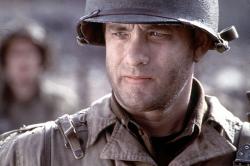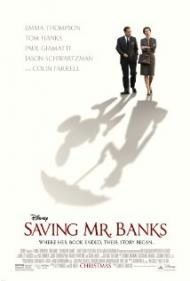



A 2002 Australian documentary on author P. L. Travers entitled The Shadow of “Mary Poppins” led to a film deal that eventually caught the attention of BBC Films. After a script was completed it became immediately apparent that they couldn't proceed without first obtaining permission from the Walt Disney Company for certain intellectual property rights involving songs and images from the movie Mary Poppins. In 2011 the head of Walt Disney Studios learned of the script's existence, and the fact that it portrayed Walt Disney, the man, as one of its principal characters. They had three choices at the time. They could purchase the rights and shut the production down, they could place the film in turnaround, or they could co-produce it themselves. The suits at Disney chose the third option. They cast Tom Hanks as Walt and Emma Thompson to play Travers (Meryl Streep was unavailable), and so after a decade of development Saving Mr. Banks finally came to fruition.
It tells two stories simultaneously. The main story centers on Travers' 1961 trip to Hollywood to work out a deal for the movie rights to her beloved children's book character, Mary Poppins. Walt Disney had long coveted the rights to the character and had promised his young daughters he would make a motion picture starring the whimsical, but no nonsense, flying nanny. Travers is shown as a disagreeable snob who has nothing but disdain for Hollywood, Walt Disney and America in general.
These scenes are interspersed with clips from Travers' childhood in rural Australia. We are given insight into what made her the woman she became. Her father was an alcoholic dreamer and her mother prone to fits of depression. An Aunt who came to stay with the family served as the inspiration for Mary Poppins herself. Unfortunately these scenes drag a bit and we could have learned just as much about her past, and its emotionally devastating affect on her life, in half the screen time. But then I guess they had to justify hiring a star of Colin Farrell's stature for what would otherwise have been a very small part.
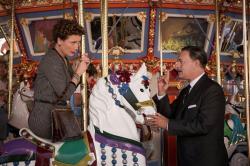
The scenes at the Disney studios in 1961 are quite lighthearted compared to the more heavy-handed flashbacks. The squaring off between Travers and Disney offers some amusing moments, as do the scenes with Travers expressing revulsion for every idea the studio comes up with. I don't know that much about the real P. L. Travers but from what little I've read about her it seems they softened her up quite a bit for this movie version. I cannot imagine the real woman having the same emotional reaction to the finished film that she is shown having at the premiere in this movie.
Tom Hanks brings Uncle Walt to life without making him a caricature. He is shown as an ambitious dreamer with a bad smoking habit (although the studio refused to allow Hanks to smoke on camera). The only concession Hanks got was being shown stubbing out a cigarette in one scene, and he coughs frequently throughout the movie. Although his is the smaller role the best scenes are those between Disney and Travers. It turns out these two iconoclasts have more in common than either of them initially suspected.
Saving Mr. Banks features many humorous moments but it's permeated with a sense of sadness. There is a melancholy atmosphere hanging over the entire film. The movie's leisurely pace adds to this sense of wistful loss; still the emotional payoff is worth the patience it takes to get there. A wonderful cast helps the story along and clips of the original Disney movie will make you want to watch Mary Poppins again. Saving Mr. Banks, while nowhere near as memorable as the movie that inspired it, is nonetheless an entertaining and moving motion picture.