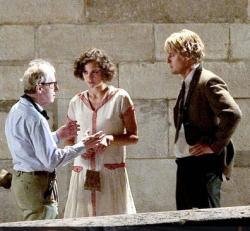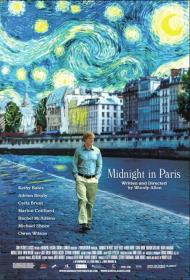



Midnight in Paris begins with a cinematic postcard montage of the titular city, much as Allen did with his beloved New York 30 years ago in Manhattan. This movie is for anyone that has ever wished they could visit a specific time and place in history. Whatever your fantasy age (I would choose 1939 Hollywood) in our imaginations we picture a highly romanticized version as glimpsed through the prism of the passing years. Woody Allen transports us to Paris in the 1920s.
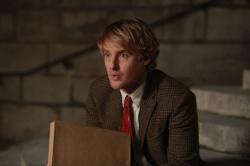
Owen Wilson takes his turn as the latest in the growing line of actors to play surrogate for Allen. He fares better than most, having the proper unremarkable looks and neurotic disposition for the part. He knows how to speak Allen’s language and mimics his nervous mannerisms without doing a parody. He plays Gil a self-proclaimed Hollywood hack on vacation in Paris with his fiancée and her wealthy conservative parents. Gil is writing a novel (set around a nostalgia shop) and harbors latent literary aspirations.
One night, while on a drunken stroll through the city of lights, (at the stroke of midnight) Gil is magically transported back to the 1920s. Like with other Allen flights-of-fancy films of the past this conceit simply has to be accepted and not thought about logically. From here the movie becomes a delightful comic fantasy as Allen lets his considerable imagination run wild.
On that first night Gil attends a party with F. Scott and Zelda Fitzgerald where Cole Porter plays piano and sings. He meets Ernest Hemingway and watches Josephine Baker shimmy. On later midnight trips to the past he gets advice on his novel from Gertrude Stein, meets Picasso and his current beautiful young lover, and has a chance encounter with Salvador Dali (among other luminaries of the day).
The cast is stellar, with the standouts being Adrien Brody for his wildly over-the-top impersonation of the famed surrealist Dali and to Corey Stoll for his hyper-masculine take on Ernest Hemingway. Allen seems to have the most fun in writing Hemingway’s dialogue, gleefully imitating the author’s famously spare writing style. The funniest exchange in the movie takes place between Hemingway and Gil. Hemingway is talking about how great sex provides temporary relief from the knowledge of one's mortality. Gil (as Allen) disagrees, replying, “No, I’ve never felt that.”
The theme of Midnight in Paris is that we often operate under the assumption that life was “better” during these Golden Ages. Ultimately Allen demonstrates the fallacy of this concept by having a character living during a so-called Golden Age who is herself pining for a previous era. “You think the 20s are a Golden Age? I long for Le Belle Époque!” Proving that for some of us at least, the grass is always greener in the past. In the process Woody gives us his third great movie of the century after Match Point and Vicky Cristina Barcelona.