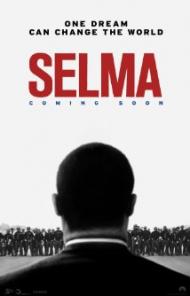



The danger of any biopic about as revered a figure as Martin Luther King Jr. is that it will treat him with such delicacy that he becomes a bland saint. That is not the case with this film. Here King is portrayed as a fully rounded and far from perfect individual. Instead of belittling his accomplishments, this actually makes them and this movie that much more impressive.
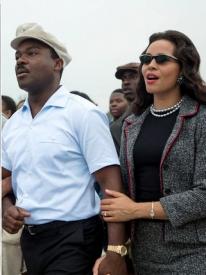
Calling this movie a biopic is actually a bit misleading as it doesn't tell King's life story, but simply one episode in it. As the title gives away, the plot revolves around the protests in Selma, Alabama, which were organized with the goal of striking down those restrictive laws that were preventing black citizens of the state from registering to vote. To show the extent of the problem, among the black population of Dallas County, of which Selma is the county seat, just 130 out of the 15,000 age eligible, were registered to vote. King and many other influential members of the Civil Rights movement descend upon the town, bringing the national media with them resulting in several clashes with the local police. A planned march from Selma to the state capital in Montgomery leads to a nationally televised attack by the police on the marchers that draws attention to the cause.
The script assumes some knowledge of King and the civil rights movement of the 1960s. There's little introduction to the characters and while the story is tense and entertaining enough to enjoy even if you aren't a student of the 1960s, having knowledge of Malcolm X, LBJ, George Wallace, and, of course, Martin Luther King Jr., will certainly help you understand the political machinations that are at work here.
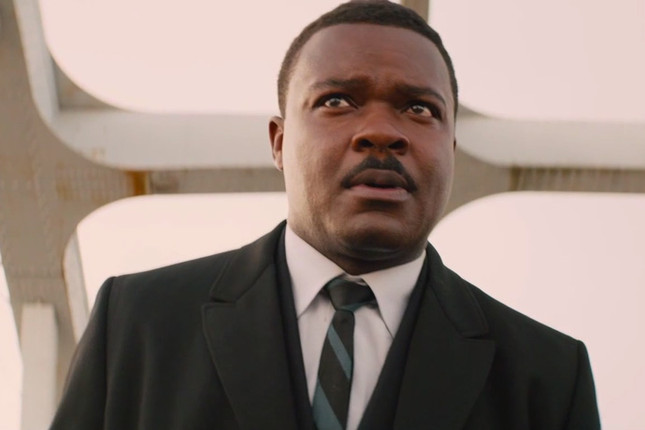
British born David Oyelowo portrays King and the awards' buzz his performance has been generating is well founded. As I said, he isn't portraying King as any kind of saint. While his goal is admirable, that certainly doesn't stop him from getting his hands dirty in the murky waters of politics. He selects Selma because it's exactly the kind of place where he knows there will be clashes and arrests and because he knows these sorts of things will generate the most publicity. We also see that he is far from perfect in his personal life and his marriage experiences a few bumps. It's not an overly showy performance, but is instead a very real one.
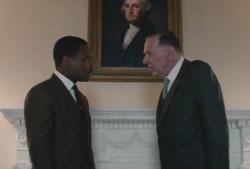
The supporting cast is also quite good and equally British for some reason. Tom Wilkinson portrays LBJ and not always sympathetically. Although he appears to believe in the theory of King's work, he views the man himself as a thorn in his side. Fellow Brit Tim Roth plays Alabama Governor, George Wallace. Perhaps casting English actors helped portray these characters as more human since presumably they weren't as indoctrinated into viewing them in the same way as an American cast would have been.
Because the film rights to King's speeches have been licensed to Dreamworks for an untitled Steven Spielberg project, this film is unable to reproduce any of his actual words. Instead, screenwriter Paul Webb has written speeches that convey the same message and in the same style. I'm not a expert on King's life, but to my untrained ear he has done a remarkable job in capturing the spirit of his words.
If the film has any weakness it is in the dialogue. It feels very stilted and overly formal even in the quieter moments between two characters. It's not always a problem, but in several scenes it's noticeable enough to take you out of the story.
Selma is a movie that succeeds on several levels. It's not just educational and historical, but also tense and entertaining.