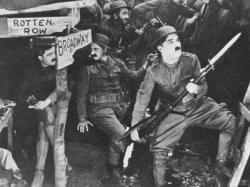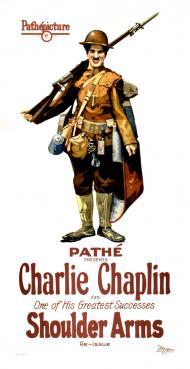



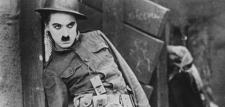
Shoulder Arms was one of the first Hollywood movies set at the front lines during the first world war. It was released some 3 weeks before the Armistice was signed at the 11th hour of the 11th day of the 11th month of 1918. Cecil B. DeMille and D. W. Griffith both advised Chaplin to wait to release the movie until after the war was officially over. Chaplin reasoned that as a comedy Shoulder Arms would add to the war effort by boosting morale.
Although the final print would run just 46 minutes, Shoulder Arms was originally intended to run 5 reels (or approximately 60 minutes). Even after some opening scenes were left on the cutting room floor this was Chaplin's longest and most ambitious Little Tramp picture to date. It premiered to huge success; adding to the fame of what was already the world’s most recognized face.
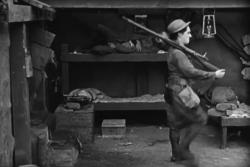
The tramp is a doughboy fighting in the trenches somewhere in the French countryside. Chaplin has a few gags about the drudgery and monotony of army life. In one scene his bunker is flooded and the tramp curls up to sleep halfway underwater. He also lights a cigarette by holding it above his head and having it lit by a passing German bullet. He opens a bottle of beer the same way.
The real action kicks in when the tramp and his buddy (played by Charlies' big brother Sydney) are sent on a mission behind enemy lines. The tramp disguises himself as a tree in a scene that would be mimicked on Gilligan’s Island and many other times. The tramp almost gets caught but hides out in a bombed out farmhouse where he meets a pretty French maiden (the always reliable Edna Purviance). To make a long story short (or a short story long), the tramp winds up capturing the Kaiser himself. If you are familiar with Chaplin I’ll bet you can guess how it all ends. But I won’t give it away here.
It’s no surprise at all that American, British and French soldiers loved this movie. It gives every soldier from General to Private his greatest day dream. To defeat the enemy single handed. This is the little tramp in action and at his most heroic; not Chaplin’s funniest Little Tramp short, but certainly one of the most historically significant.