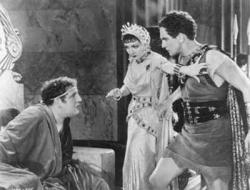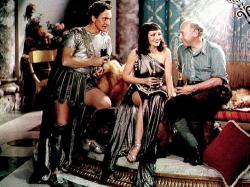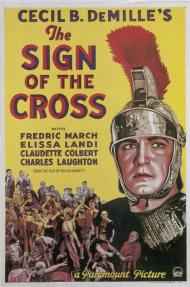



The Sign of the Cross is a big old-fashioned epic as only Cecil B. DeMille could make. It takes place in Rome in 64 A.D. and is filled with sights and spectacle and features a cast of, if not thousands, than at least hundreds. It also benefits heavily from and gets away with things because of it being released prior to the Hays Code being enforced. It was the Caligula of its day.
As the movie opens, Nero (Laughton) is playing the lyre while Rome is burning. To avoid rumors that he started it, he puts the blame on the Christians and offers a reward for every Christian captured. It works according to plan until Marcus (March), the Prefect of Rome, falls in love with Mercia, a Christian girl (Landi). This doesn't sit well with the Empress (Colbert), who lusts after Marcus. She conspires to have Mercia put to death in the colesium along with all the other Christians. Will Marcus be able to save her? And will he understand the depth of her belief and what she's prepared to do for it?
DeMille's speciality was spectacle and there's plenty of it on display here. The final half hour of the movie is nothing but spectacle. It takes place in the arena and features battling gladiators, midgets fighting amazons, a woman being eaten by alligators, another woman being stalked by a gorilla, and Christians being fed to the lions. Even before the giant finale though, the sets and the costumes are quite elaborate and there is plenty to look at, especially in the pristine, restored edition of this movie that is now available.
Unfortunately the performances aren't as good as the sets and art direction. Most of them are rather hammy and over dramatic. I would blame the time period since in the early 30s, there was a tendency towards melodrama, but if you watch later DeMille epics, like 1956's The Ten Commandments, the acting is just as over-the-top as it is here, so maybe DeMille is more to blame than the period. Only Colbert as Poppaea manages to restrain her performance and she subsequently steals every scene that she's in.
There are several scenes that caused the filmmakers trouble with the censors, but were kept in the film since there was no real way for the Production Code to be enforced at the time. When the movie was rereleased a few years later, after the Code, these scenes were removed.
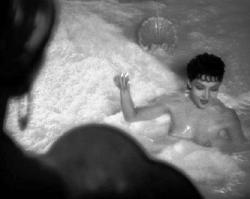
The most famous of these scenes is Colbert bathing in asses' milk. There's no actual nudity, but you can definitely tell that she is naked as her breasts float on the milk, coming within an eyelash's breadth of revealing nipple. The scene ends when Poppaea tells another woman to take her clothes off and join her in the bath and the camera pans to the woman's legs and you see her skimpy dress fall to the floor.
There are several other shocking for the times scenes. At one point one woman dances seductively while she caresses another woman in an attempt to warm her up to Marcus' advances Later, a nearly nude woman is tied to a stake as a gorilla approaches her in the arena (since gorilla's aren't meat eaters, I guess it's up to you to decide what he's going to do with her). Nero, played very camp by Laughton, keeps a naked male slave beside him while he watches the debauchery at the arena.
You certainly could never accuse DeMille of not giving audiences bang for the bucks and this movie is no exception. Even at this movie's weakest points, it still manages to entertain by the sheer volume of images he throws on the screen. He was the master of the religious epic and is hardly likely to ever be topped.