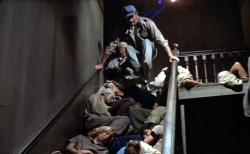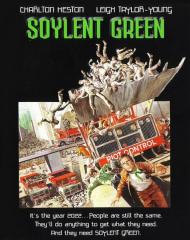



Soylent Green epitomizes 1970's dystopian future movies. It takes place in the year 2022. The population of New York City is a staggering 40 million souls. Homeless people crowd apartment stairways with an armed guard stationed on each landing. Air pollution has caused the earth's atmosphere to grow warmer, a phenomenon quaintly referred to in the movie as the greenhouse effect (this would later be changed to global warming and - as of this writing - is now called simply climate change). With depleted natural resources and dying oceans the future of humanity looks very bleak indeed.
Real food is scarce and exorbitant in price. Something only the securely sequestered rich can afford. A jar of strawberries, for example, costs 150 bucks. Feminism seems nonexistent in this cruel future, as prostitution has been legalized in the form of female “furniture” that is included in the rent at luxury condos. Although this movie was set 50 years in the future from the time it was made the cars, fashions and television sets are all clearly of the 1970s. In one scene a woman plays a laughably primitive “futuristic” video game that looks like a cross between Pong and Space Invaders.
The masses subsist on government issued crackers of various hues called Soylent Yellow, Soylent Red and the new, more nutritious, Soylent Green. This last variety is in high demand and short supply, which causes riots. This leads to one of the movie's most dated, and unintentionally funny, sequences. Their form of riot control consists of sending in bulldozers – or Scoops as they are called here – to physically remove the out-of-control populace. The crowds scream in terror as they are literally scooped up and dumped in the back of these incredibly slow moving trucks.
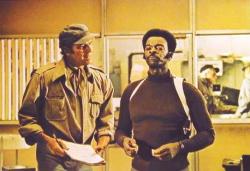
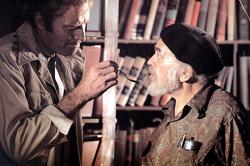
An aging Charlton Heston stars as Robert Thorn, a tough NYC detective investigating the murder of a wealthy and important citizen (an elderly Joseph Cotten in a small part). Thorn lives with his partner and best friend Sol Roth (an ancient Edward G. Robinson in his final screen role). Sol is old enough to remember Earth as it was before pollution and overcrowding turned it into a daily fight for survival. As he often tells Thorn, “Why, in my day you could buy meat anywhere! Eggs they had. Real butter! Fresh lettuce in the stores.”
Sol provides the movie its soul. Robinson died of cancer shortly after filming was completed. The scene where Sol goes “home” being the last scene he ever played on camera. This sequence, with its classical music and panoramic shots of nature, is the best moment in the movie and elicits a genuine emotional response from the viewer. Thorn breaks down in tears in one of the most touching moments Heston ever played onscreen. Soylent Green depicted a form of euthanasia several decades before the term acquired widespread familiarity.
SPOILER ALERT: Thorn's investigation (or more precisely Sol's) eventually leads to the uncovering of a massive conspiracy, at the center of which is the secret ingredient being used in the popular new green crackers. The movie ends famously. The big revelation is made and a mortally wounded Thorn screams it out as he's being carried off on a stretcher, “Soylent Green is people!” Not exactly an uplifting ending but it is a memorable one.
Soylent Green is dated and unintentionally silly at times but it remains a fairly entertaining combination cop movie/science fiction film. It is of historical interest to movie buffs as the last fictionalized movie to feature scenes shot on MGM's famous backlot in Culver City (narration sequences for That's Entertainment! would be the final scenes of any kind filmed there before it was bulldozed to make way for condominiums). Today Soylent Green is still worth watching, especially for Edward G. Robinson's heartfelt final performance.