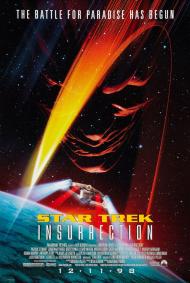




My most common complaint about the Next Generation movies is that they often seem more like extended episodes from the television series than they do like movies. Never is that more true than with Star Trek IX. It contains a few nice character moments, but the central plot seems rather tame. In the previous film the crew was saving the Earth, this time around they're preserving the hippy lifestyle of 600 people. It's not exactly the stuff of legend.
The gist of the plot has the Enterprise travel to a planet hidden in some kind of cloud to investigate why Commander Data, who has been temporarily assigned to monitor the planet, has gone berserk. Turns out that the planet's rings generate a radiation that acts as a fountain of youth. Certain members of the Federation, partnered with a race known as the So'na, plan to remove the 600 inhabitants of the planet so that they can harvest the radiation. Picard objects to the plan and defends the planet while Riker takes the Enterprise to alert the Federation Government and Starfleet to exactly what is happening.
Like the best of Star Trek, this movie tries to present a question of morality. Picard asks, how many people have to be displaced before it becomes wrong. Comparisons could be made to the forced removal of Native Americans from their lands. The only problem with this is that, while I disagree with their methods, I actually agree with the intentions of the So'na and the Federation members working with them. Why should immortality be limited to just these 600 people? Is preserving their hippy dippy lifestyle worth the cost of billions of lives? Instead of just removing them though, or even worse, killing them, shouldn't they be trying to work out some kind of compromise? And shouldn't these supposedly superior people be willing to share their unique gift? It's not even as if it were their planet. They migrated there 300 years ago.
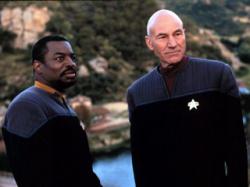
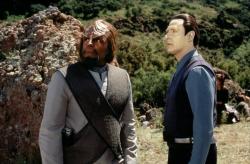
Frakes does a decent job directing again, but the script is weak. They do throw in some nice scenes for the characters. Due to the regenerative power of the planet's radiation, Geordi gets his eyesight back and Riker and Troi renew their relationship. Another excuse is found to bring Worf back onboard and he provides a few moments of comic relief as he starts to experience Klingon puberty. Data's quest to be more human seems increasingly tired as it's trotted out one more time. Spock found peace with his nature in the later films, couldn't Data as well? Only poor Beverly Crusher is left with nothing to do except mention how her boobs are firming back up.
Star Trek villains have never been the movies' strong point. Khan and the Borg Queen are probably the best they've produced. F. Murray Abraham as Ad'har Ru'afo is certainly one of the weakest in all of the movies. He is written as a whiny and spoiled child who reminded me a bit of Daffy Duck and you expect him to jump up and down screaming, "Mine, mine, mine" at any point.
After being involved with seemingly a series of diplomatic missions, Picard asks near the beginning of the movie, "Remember when we were explorers?" My answer is, Yes. Yes, I do. I remember when the Enterprise's mission was to explore strange new worlds, to seek out new life and new civilizations and to boldly go where no one had gone before. There's nothing strange, new or bold about this movie and we definitely don't go somewhere we've never been before.