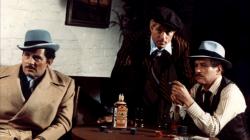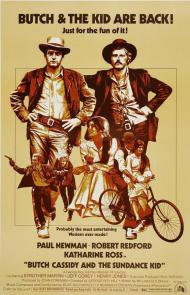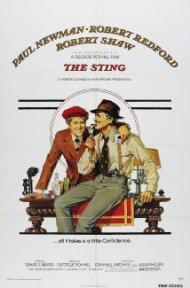



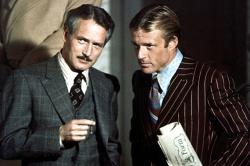
After the success of 1969's Butch Cassidy and the Sundance Kid, directed by George Roy Hill and starring Paul Newman and Robert Redford, a follow-up film reuniting the trio seems almost inevitable, and yet The Sting, the film that brought them back together, was never originally intended to do so. Writer David S. Ward wrote the script with Redford in mind, but the writer wanted to direct it himself. Redford, however, was nervous about starring in such a big film with a novice director and agreed to star only on the condition that an experienced director take the helm. That brought Hill onto the project who happened to show the script to Newman, but the part of Gondorff was a small one, written for an older, rougher man and it was only after some back and forth and some rewriting that Newman signed on as well. The only question was could the trio recapture the magic that made Butch and Sundance such a hit? Turns out they could as audiences and critics alike ate up this story of con artists in the 1930s set to the ragtime soundtrack of Scott Joplin. The Sting became the second highest grossing movie of the year (behind only The Exorcist) and was nominated for 10 Academy Awards, winning 7, including Best Picture and Director.
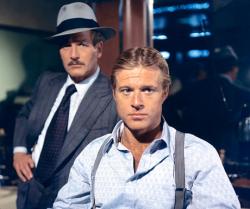
Even with the rewrites and the expansion of the Gondorff character, this is Redford's film rather than a true partnership. Both stars' names appear above the title, but Newman's part really is a supporting one. Redford plays Johnny Hooker, a young con artist (Redford was 37, but is treated as though he's younger) whose partner is murdered after it turns out the mark on whom they've worked a con was actually a runner for the mob. Hooker goes on the lam himself, taking refuge with Henry Gondorff (Newman), an experienced con artist. Hooker persuades Gondorff to help him get revenge on Doyle Lonnegan (Robert Shaw), the mob boss who ordered the hit on Johnny's partner. Their con is fairly elaborate, although simple at its heart. It involves a cast of colorful characters and has a few twists inside its turns that makes it seem more complicated than it really is. Trying to stay one step ahead of the cons is part of the fun of watching.
Redford garnered his only acting Oscar nomination to date for his portrayal of Johnny. He's good in the part, but it doesn't really feel like an Oscar worthy performance. It's a little light for that. He was certainly in good company that year. What other year can brag this list of Best Actor nominees? Jack Lemmon (who won), Marlon Brando, Jack Nicholson, Al Pacino, and Robert Redford. Against that sort of competition, Redford didn't really stand a chance. Not that he isn't good in the part. As he proved in The Great Gatsby and The Way We Were, period costumes suited him, particularly those of the first half of the 20th century.
Although once again Redford and Newman shared their magic chemistry, their screentime together is quite limited. Newman is absent for much of the third act. Robert Shaw as the villain Lonnegan has more screentime than Newman and is terrific in his part. He has to play the dupe, but he manages it without seeming stupid and remains believably menacing throughout.
Director Hill was reportedly inspired by the gangster films of the 1930s and he works in many old fashioned elements into his direction. The colors are muted and the edits are done through wipes and closing irises. The stages of the con are separated by title cards done in the style of "The Saturday Evening Post" from the era. The ragtime music by Scott Joplin, arranged by Marvin Hamlisch, is anachronistic. It was popular decades before the 1930s, but it suits the story and is instantly memorable, particularly the jaunty "The Entertainer", which became a top ten hit more than 70 years after Joplin wrote it.
Also helping to evoke the era are the costumes of legendary designer, Edith Head. Born in 1897, Head probably designed the suits from memory. She won her 8th and final Oscar for her work on this film. While accepting her award she said, "Just imagine, dressing the two handsomest men in the world and then getting this."
Although not an outright comedy, the tone of the film is very light, which makes it something of an anomaly for a Best Picture winner, since the Academy usually rewards more serious fare. It's this lightness of tone though that is the secret of the film's success. By keeping things light and jaunty, despite a couple of darker moments, the story breezes by. It's a fun watch, which isn't something you can usually say about Best Picture winners.
After proving for a second time how good they were together, it's surprising that Redford and Newman never worked together again. This is especially odd when you consider that the two remained friends for the rest of their lives. As recently as this year, in Captain America: The Winter Soldier, their limited partnership was referenced when Redford's character opens his refrigerator to reveal to sharp-eyed viewers that it is stocked with Newman's Own products, complete with Paul Newman's grinning face on them. It's a testimony to their chemistry that despite just appearing together twice, that they will forever be linked in our collective memory.