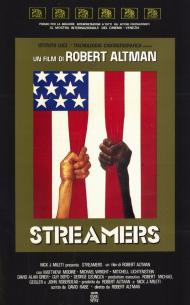


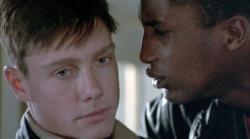
Streamers was the twenty-first motion picture directed by Robert Altman. It came during a phase in his career in the early 1980s when he was adapting stage plays for the big screen. The all-male cast of Streamers was in direct contrast to his previous year's nearly all-female movie Come Back to the Five and Dime, Jimmy Dean, Jimmy Dean. In both movies Altman remained true to the source material without trying to open them up for the screen.
Streamers takes place entirely in one night in an army barracks in 1965 as six American soldiers await their orders to ship out to Vietnam. Over the course of this one night the drama quickly escalates until it reaches a sudden and explosive boil. Issues of race and sexual identity are examined as four new recruits and two veteran sergeants (both of whom spend the entire movie drunk off their asses) are forced together as they mentally prepare for war.
The screenplay was adapted by David Rabe from his play. Rabe based it on his own experiences as an army draftee serving in Vietnam. It was the third play in his trilogy dealing with the war, following Sticks and Bones and The Basic Training of Pavlo Hummel. The title refers to the word the soldiers use to describe a parachute that fails to open but instead streams in the air as the soldier plummets to his death.
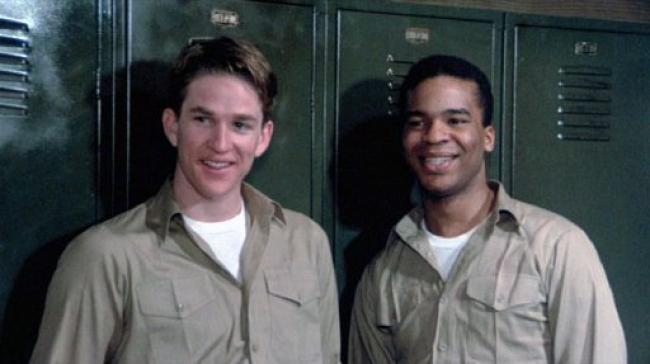
Streamers tells a brutal story that is akin to watching a six car pile-up on the freeway. These men create tension through their own ignorance and intolerance of others who are different from themselves. Billy (Matthew Modine) is a conservative country boy, Roger (David Alan Grier) is a middle-class African-American, Richie (Mitchell Lichtenstein) is a rich kid who also happens to be unabashedly gay, and Carlyle (Michael Wright) is a volatile black man from the streets. Streamers is a violent clash of these disparate personalities.
The camera never leaves the inside of the barracks. In one scene Billy and Roger are playing basketball outside and they are shown through the window, at one point we overhear their conversation but the camera (and the audience) stays inside this one room. This forces the viewer to share the sense of claustrophobia felt by these characters. This technique serves the material well.
The one problem that comes with filming a stage play as a movie while remaining this true to the source is the fact that in a play the audience member can choose where to focus their attention at any given time. Watching a movie, however, we are completely at the mercy of the director and where he chooses to focus his camera. There are a few times when I would have preferred to watch the entire group interact but Altman instead chooses to zoom in on just one actor. It doesn't detract much from the story but it does prove that no matter how true to the play you attempt to be when making a movie, you can never fully duplicate the experience on film.
Streamers is extremely well-acted. In fact, in a very rare occasion, the entire cast was awarded the Best Actor Award at the 1983 Venice Film Festival. This was David Alan Grier's film debut, and although he is best known as a comedic actor, he proves himself equally adept at playing drama. Matthew Modine is also quite good in the role of Billy, as is Mitchell Lichtenstein as the flamboyant Richie. But for my money the two outstanding performances belong to Michael Wright as the tragic Carlyle and George Dzundza as the constantly inebriated Sergeant Cokes.
Streamers isn't for the faint of heart. It is brutal and violent and lacks a happy ending. But it is a powerful piece of filmed drama.