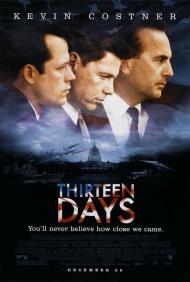



Most movies are predictable. You know how they are going to end. The good guys will win. The bad guys will lose. Occasionally, Hollywood will slip one through that doesn't turn out exactly like you'd expect, but those are rare and far between. Therefore it is not the outcome that makes a movie good, but rather how the movie reaches that outcome. As someone said, 'The journey is its own reward.' Which is why a movie like Thirteen Days, where the outcome is a matter of historical record, can still be tense and entertaining.
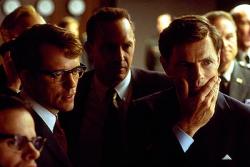
Before this movie started, I knew that the Russians pulled their missiles from Cuba, I knew that President Kennedy was known as a hero because of his command of the situation, and I knew that the general public was in a state of panic, convinced that those 'dirty reds' were going to bomb us. The pleasure in this movie is watching the characters come to terms with the situation and attempt to come up with a solution that won't end in the world going to war.
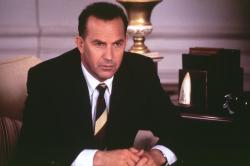
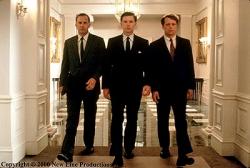
Kevin Costner stars in the film as JFK's personal aide. Unlike a great many people, I actually enjoy Kevin Costner. Although he doesn't always pick the best movies, I think he is an underrated actor. I particularly enjoyed him in the Clint Eastwood directed A Perfect World. Just keep him away from movies about the post apocalyptic future. And he does a decent job in this movie except for a few scenes of melodramatic dialogue which I blame on the writer and director rather than him.
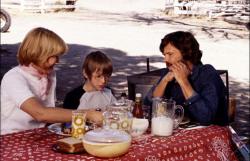
Which brings me to what I didn't like about this movie. I didn't like, as I mentioned, some of the dialogue. During the tenser moments, it is fine, however, when Costner's character is at home with his wife and kids, it tends to go a little over the top. Specifically, I am referring to Costner's comments about the sun coming up, when he is sitting at the breakfast table. This is in reference to an earlier conversation between him and his wife about how they wonder if they will ever see the sun come up again. A simple moment of him looking out the window at the sunrise would have sufficed to get the message across, but instead we must have the theme beaten into us by an inane piece of dialogue.
This movie is also presented in a very one-sided way. The Russian side of the story is left untold. Now that the cold war is over and the Russians are no longer cast as black hearted villains, it would seem more appropriate to allow at least part of their story to come out. We are presented with Kennedy's battle to decide his course of action, and it would have added to the movie, I feel, if we could also have seen Khrushchev making some of the same decisions.
So while this is a good movie, it is just those little nagging items that keep it from crossing the line into greatness.