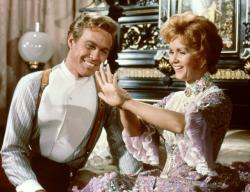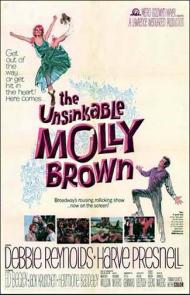


Based on the hit Broadway Musical of the same name, The Unsinkable Molly Brown represented not only the pinnacle of Debbie Reynold's movie career, it also marked the end of an era at MGM. It was the studio's last big musical production and it came at the tail end of the golden age of the Hollywood movie musical. It was the final musical directed by Charles Walters, as well as being legendary producer Roger Edens' swansong at Metro (he did produce one final musical, Hello Dolly! over at Twentieth Century Fox).
Some fans of the Broadway production were disappointed that Tammy Grimes wasn't allowed to reprise her Tony winning role from the stage. The director's first choice was Shirley MacLaine but when she was unable to get out of her contract with Hal Wallis, Debbie Reynolds ultimately secured the role of the uncouth hillbilly from the backwoods of Colorado who becomes the toast of Europe before surviving the sinking of the Titanic.
Much of the film is apocryphal, such as Molly surviving a flood on the Colorado River as an infant (in the movie's opening scene), or when Molly hides $300,000.00 in the stove only to have her husband burn it up. Other details of her true life were altered or left out completely, like the fact that in real life Molly and Johnny Brown had two children. Molly Brown has become a mythical American figure and her story, as told in this film, is a simplified tall tale set to music.
After her husband strikes it rich with a gold mine, Molly insists they move to Denver where she attempts to break into high society, only to be rebuffed at every turn. On the advice of a friendly monsignor, Molly and Johnny take an extended trip to Europe where she charms the jewels off of the crowned heads. Whereas her uncouth behavior and general tackiness only served to remind the social elite in Denver of their humble beginnings from a generation or two earlier, her earthy sense of humor and genuine personality are fully appreciated by the Europeans and she becomes a celebrity. She gains some culture, acquires a fashion sense, learns to speak several different languages and returns triumphantly to Denver with her new royal friends in tow.
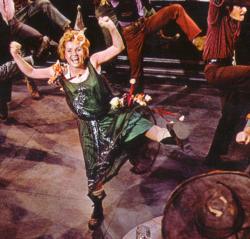
Reynolds gives her all from beginning to end. Her energy and enthusiasm never waver. She sings, dances, acts, fights and yells her way across the screen. Some have criticized her performance for being more athletic and vigorous than artful but she does what the part requires and that is to be larger than life every single second. One thing I liked about her approach is that Molly never manages to smooth out all of her rough edges. This isn't an Eliza Doolittle type of total personality transformation. Sure she gets more sophisticated but she stays pretty much the same person in the process. Her grammar improves slightly and her gruff speaking voice occasionally softens a bit, but in many ways she remains the same simple but blindly ambitious backwoods gal who made good. Reynolds was deserving of the Best Actress Oscar nomination (she lost to Julie Andrews in Mary Poppins). This would be Debbie's sole Oscar nod in her long career.
Only a handful of songs from the Broadway score made it into the film. The most famous being “Belly Up to the Bar, Boys” sung with gusto by Reynolds and company when she gets her first job at a saloon, and done as a reprise later in the film. The tall, handsome Harve Presnell was the sole member of the Broadway show to repeat his role for the screen, making his movie debut as Johnny Brown, a man so smitten with Molly that he'll do anything to win her heart. This is best demonstrated in the number “I'll Never Say No”, the lyrics to which he proceeds to live up to throughout the movie (with one notable exception). Presnell's wonderfully mellifluous singing voice perfectly suits the film's setting. The panoramic outdoor scenes were shot on location at a national park in Colorado. Harve's booming voice fills the canyons and he sings the lion's share of the songs.
As pure Hollywood entertainment The Unsinkable Molly Brown delivers. It's quite funny. Molly's homespun folksy one-liners are often amusing, with Reynolds' seemingly inexhaustible gusto helping to sell them. The romance between Molly and John is sweet and charming. Sparks may not fly between the two leads but both actors successfully manifest the depth of the love felt between these two. The supporting cast is filled with talent. The standouts are George Mitchell as Monsignor Ryan and Martita Hunt as the Grand Duchess Elise Lupavinova. Hunt steals the climactic ball sequence.
It's no wonder that Debbie Reynolds calls this her favorite role. It's the part of a lifetime and she knew it. The one thing you can't say about it is that she didn't give her all. The Unsinkable Molly Brown has its flaws but it was a big hit with audiences and critics alike in 1964. All things considered it's not a bad way for the era of the classic MGM musical to come to an end.