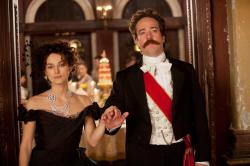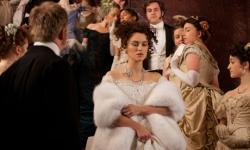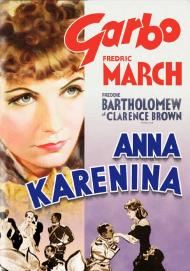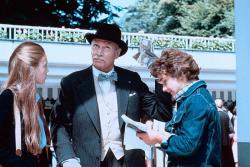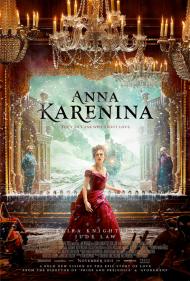



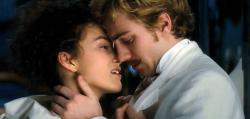
Anna Karenina has a long screen history dating back to 1910. Greta Garbo played the role twice, in a silent movie called Love, and then most famously in the critically acclaimed 1935 version produced by David O. Selznick, directed by Clarence Brown, and costarring Fredric March. Vivian Leigh gave us her Anna Karenina in 1948 and there have been at least another half dozen versions made in the decades since.
Leo Tolstoy's classic Nineteenth Century Russian novel's latest screen adaptation, by director Joe Wright, is a lush and fanciful feast for the eyes. With a screenplay by Tom Stoppard that sticks faithfully to the author's original story (and beautifully handles its central theme of the consequences (and hypocrisy) of societies' treatment of a woman who dares go against accepted moral behavior), and a talented cast of actors to bring these iconic characters to life, this should have been a great movie.
It isn't, due to two big flaws.
First of all, the director's decision to place half the action on a stage seems odd. Yes it's visually interesting and allows for some creative artistic flair in scene transitions, but juxtaposed as they are with scenes set in the real world, it gives the movie a schizophrenic, disjointed feeling. I would have preferred the movie to be set entirely in the real world, but had the director remained consistent with the stage concept I would have appreciated it more than this bizarre combination of the two.
The sets and costumes are undeniably sumptuous and it's gorgeously filmed. It should garner Oscar nominations in those three categories at least.
The second flaw is the central performance by Keira Knightley. She is an undeniable beauty. Her stunning looks perfectly suit the role. But only on the surface is she a convincing Princess Anna Arkadyevna Karenina. The Anna of the book is a Great Lady. A woman capable of having a passionate, all-consuming affair and behaving in the most selfish manner while retaining her decorum and class. In Knightley's hands she comes across more as a well-dressed tart in serious need of hot sex. Where is the confident, noble woman with perfect manners who knows how to make everyone around her instantly comfortable in any social situation? This Anna seems weaker and more of a victim. But then who could ever surpass the Great Garbo in this role which she was born to play?
The supporting players are well-cast. Matthew Macfadyen provides some levity as Oblonsky. Domhnall Gleeson brings the right combination of noble intelligence and social awkwardness to Konstantin Levin, and Alicia Vikander as Kitty is the picture of gentle womanly innocence. Their happy tale of love (at least by Russian novel standards) contrasts sharply with the tragedy of the central romance between Anna and Vronsky.
Speaking of Count Vronsky, Aaron Taylor-Johnson brings the dashing officer to life. His rakish good looks with his piercing blue eyes, curly blond hair and carefully trimmed mustache combined with that tight white uniform, makes it easy to see why Anna would prefer him to her plainly dressed, and pious husband. Which brings us to Alexei Karenin, skillfully embodied by Jude Law. In what has to be one of his very best performances, Law makes Karenin more sympathetic than he is usually portrayed. In this unassuming (and thankless) role he shines bright and of the entire cast he alone deserves Oscar consideration.
I enjoyed this movie for the most part, particularly in regards to its fairly faithful adaptation of Tolstoy's book. It helps if you've read the novel. The highly artistic style in which it's filmed is both a plus and a minus. At times it helps move the story along quickly from scene to scene, but at other times it seems overly pretentious (the horse race scene for example). I liked the cast with the exception of Knightley as Anna. The pacing could have been swifter, especially during the final 30 minutes. We all know Anna is heading for that fateful final rendezvous with a locomotive but it sure takes a while for Wright to get her there.
This Anna Karenina is a visually interesting attempt to bring a new perspective to the classic story but I'll stick to the 1935 version, thank you very much.