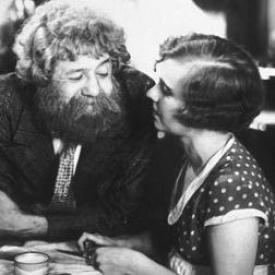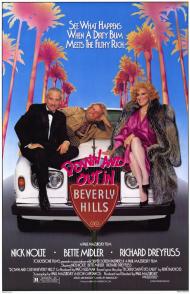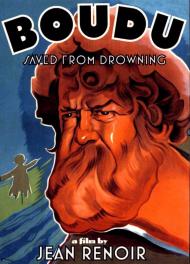


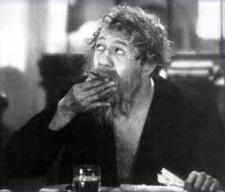
Boudu Saved from Drowning (Boudu sauvé des eaux) was just the 4th movie from French director (and son of the Impressionist painter Auguste) Jean Renoir to have sound. It is a comedy that was adapted from the play of the same name by René Fauchois. Like most of Renoir’s films it deals in social commentary. It would be remade in Hollywood more than 50 years later under the title Down and Out in Beverly Hills. Nick Nolte recreated the tramp character originally played by Michel Simon, a well-known character actor in France, who continued making movies up until his death in 1975.
A wealthy Parisian bookseller witnesses a tramp attempting suicide off a bridge over the River Seine. He rescues the tramp, brings him home and welcomes him into his household with farcical results. Michel Simon steals the movie as the deranged tramp, Boudu. His facial expressions are priceless. He is rude, uncouth and disgusting in his personal habits. Before long he is having an affair with his benefactor’s wife and trying to seduce one of his maids (the same maid the man himself is sleeping with).
There are quite a few laughs that also poke fun at social class. Early in the movie Boudu is sitting on a park bench. A wealthy woman instructs her young daughter to give some money to him as he is underprivileged. The tramp asks her what the money is for and the girl tells him it is to buy bread. Cut to a wealthy looking man sitting in his expensive looking automobile. Boudu approaches him and the rich guy searches in his pockets ostensibly looking for money for the tramp. The tramp then gives the money the little girl gave to him to the rich guy. The rich guys asks if he is being made fun of. Boudu tells him the money is to buy bread. I realize this doesn’t “read” funny but the way Renoir shoots it and the way Simon delivers the line, trust me it is. In another scene the bookseller discovers that Boudu has spit into one of his books. He says in disgust, "The man who spits in Balzac's 'Physiology of Marriage' is less than nothing to me."
The black & White cinematography and the camera work are quite sophisticated for 1931 when this movie was shot. It is also historically fascinating as a glimpse of Paris nearly a century ago. The ending is satisfying if somewhat predictable. Boudu Saved from Drowning is a cinematic gem from France showing the early work of one of that countries most celebrated directors.