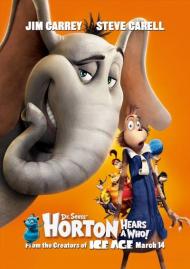




Horton Hears a Who is a story that could be taken in many different directions. The essence of the story is that Horton, and by extension all of us, can believe in something that we cannot actually see or touch. This could have religious connotations or it could be simply about using your imagination. Hollywood is not going to put together a movie that actually supports any sort of religious belief, so it predictably takes the imagination route.
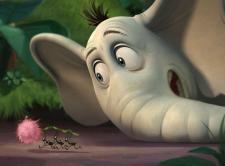
One day in the jungle, an elephant named Horton hears a voice coming from a dust particle on top of a flower. Horton is a teacher. His students all instantly believe him about the voice coming from the speck on the flower. They all follow his lead and carry their own flowers with them. One student has my favorite line in the movie when she describes the world on her flower. "In my world everyone is a pony, and they all eat rainbows, and poop butterflies."
Carol Burnet plays a dissenting Kangaroo who proudly announces to the other mothers that she home schools her child. For whatever reason, she hates the fact that Horton has all of the children believing his story about hearing a voice. She cons Vlad, the evil vulture, not the bunny that brings cookies, to steal the speck and destroy it.
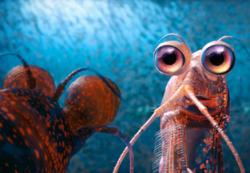
Horton must avoid Vlad, the Kangaroo and some banana toting monkeys to get the speck to a safe location. Meanwhile, the occupants of the speck are those Christmas loving Whos from Whoville. Sadly, no mention is made of the Grinch. The Mayor makes contact with Horton and he has the same problem of trying to convince his townsfolk that he is in contact with a being larger than they can comprehend. He also has 96 daughters and one angst filled son.
The makers of this film could have easily gone with subtle references to God. Someone believing in something that cannot be seen or felt, which motivates them to do something good is just ripe with religious symbolism. But who am I kidding? This is a Hollywood movie, where swearing, sex, nudity, drug use and anti America themes are always welcome but not religion, unless it is being blamed for something.
This movie could have been political. A teacher is code for a liberal and a person who home schools is obviously a conservative. They dissagree with each other and the teacher is, of course, shown to be in the right. (or is that left?) You are probably thinking that I am trying to read way too much into this children’s story, but I disagree. Dr Seuss’s books were about getting children to think. The Cat in The Hat is about imagination and Green Eggs and Ham is about trying new things. This movie never really says why anyone cares about what Horton does or does not hear. Greater religious or political subtext could have added immensely to this otherwise forgetable film.