



Ex Machina is a thought provoking science fiction film that raises questions about conciousness, artificial intelligence, and what our perceptions are, particularly when sex is brought into the equation. The film is written by Alex Garland, author of 28 Days Later and Sunshine (both directed by Danny Boyle) among others. Unlike those earlier films, Garland also directs this one. It's a slickly packaged, well acted film whose only real weakness is its slow pace that results in a film that runs about 15 to 20 minutes too long.
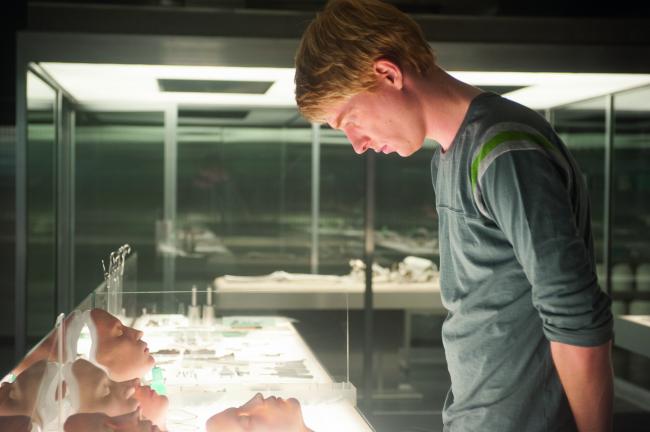
It certainly wastes no time in getting to its main premise. The story opens with Caleb (Gleeson), a programmer at Bluebook (think Google), who wins a Willy Wonka type lottery where the prize is getting to spend a week at reclusive Bluebook CEO Nathan's remote estate. Once he arrives he learns that Nathan has developed a robot with artificial intelligence. He tells Caleb that he wants him to put this robot through its paces and, using the Turing Test, prove whether or not it has conciousness. The rest of the film takes place over the course of the week with Caleb spending solitary time with the robot, who Nathan has named Ava, and with Nathan himself, most often as Nathan gets drunk.
Ava is played by Alicia Vikander and although quite overtly robotic, she is most definitely feminine. The only flesh covered portions of her body are her face, hands and feet, but it's enough, particularly when accompanied by her need to be rescued, to bring out the protective male response in Caleb. As the week goes by we start to realize that the test isn't quite what Nathan first described and that Caleb is just as much of a guinea pig as Ava.
The majority of the film takes place at Nathan's remote home (in reality a hotel in Norway), with just the three main characters as its focus. Fortunately they all do a superb job of acting. Oscar Isaac is arrogant as hell as Nathan, counting on his wealth and high IQ to make him always correct. Gleeson is the naive young man, at first in awe of his employer and easily manipulated by insecurities. Alicia Vikander captures the combination of innocent sexuality and other worldly nature of her character perfectly.
While all of the proceedings do provide some food for thought, at nearly 2 hours, there's room to pick up the pace. Instead, Garland keeps things moving very slowly and deliberately. There's a lack of urgency to the proceedings despite the countdown clock nature of the story with its set timeline of one week. There are inevitable hints to how it will end, but I wanted it to get there quicker.
The only action comes at the film's climax and it leaves the possiblity of a sequel should Garland wish to make one. There's enought left to explore with the character of Ava and any number of ways the story could go. And when a story leaves you wanting to know more about the central characters and what will happen to them after the credits roll, that has to be a good thing.