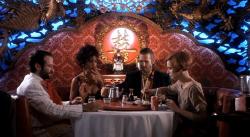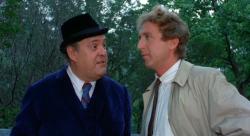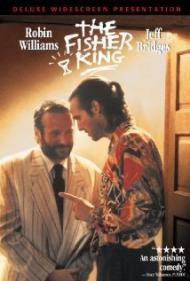



In many ways, Fisher King represents director Terry Gilliam's most mature work. For once it's the actors who are the main attraction and his unique visual style only serves the story rather than dominating it. Although it contains elements of the fantastical, at its heart, it remains grounded in reality. It remains the only film of his to receive an acting Oscar, with Mercedes Ruehl winning for Best Supporting Actress. Williams was also nominated for an Oscar and won the Golden Globe for Best Actor in a Musical or Comedy. The script by Richard LaGravenese, which was also Oscar nominated, combines humor and drama to great effect.
Although Ruehl and Williams both received more attention for their acting than Bridges, watching it for the first time in many years, it was his performance that stood out the most to me. Williams and Ruehl are both playing large characters and they do good work, but Bridges is much more subtle and nuanced. Williams tries to steal his scenes with humor, but this is Bridges's film and he holds it together. It's the story of his character's journey toward redemption. Perhaps it's because his character isn't very likable through much of the film that kept audiences from sympathizing with him.
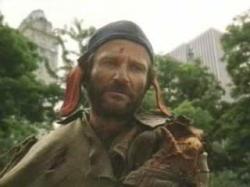
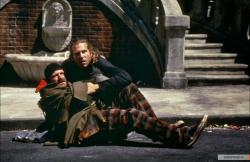
Bridges plays Jack, a successful radio shock jock in New York City in the early 1990s. When during one of his rants he tells a mentally disturbed caller that yuppies at a certain fashionable bar need to be stopped, that caller takes a gun to that bar and goes on a killing spree. We then cut to some time later with Jack's career gone and he is living with Anne (Ruehl) above the video rental store that she owns. Wracked with guilt and depression, Jack is now a drunk. During one night spent wandering drunkenly around the streets of the city, he is rescued from an attack by a couple of teenagers by Perry (Williams). Perry is mentally unbalanced, believing himself to be a knight errant. He speaks to people who aren't there and thinks that the Holy Grail is located in a mansion on the Upper East Side. When Jack wakes up in the basement that Perry calls home, Perry tells him that he thinks Jack was sent to help him retrieve the grail. Later Jack finds out that Perry used to be a professor, but he went a little crazy when his wife was killed during the attack in that bar that Jack blames himself for. With that in mind, Jack decides that if he can somehow save Perry, or make it up to Perry, that he will be able to find peace for himself.
Despite the heavy concept, the script contains plenty of humor. Perry's manic personality, played as only Robin Williams could, provides much of the humor. His interactions with Jack's much more repressed persona is the source of many jokes, such as when Perry goes naked in Central Park at night, while Jack looks on in horror. Michael Jeter is also quite funny as the homeless cabaret singer who lends Jack a hand by singing a version of "Everything's Coming up Roses" in a crowded office. Amanda Plummer also generates a few laughs as the quirky object of Perry's affections. But there are plenty of smaller funny moments throughout the film, like Jack's video recommendation to an energized video customer played by Kathy Najimy.
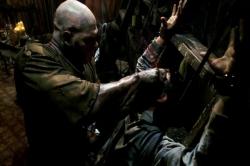
Gilliam's decision to make this film came as a result of his experience on The Adventures of Baron Muncheusin, which was a nightmare production that ran long and far over-budget. He decided to make a lower budget film set in the modern world. The setting forces him to restrain his usual visual flair, but he still manages to make his mark. Perry's madness is represented by the Red Knight who appears before him when the border between sanity and fantasy becomes too thin. Seeing the large knight, galloping through the streets of Manhattan, breathing fire, in full armor, is an arresting vision. Gilliam also makes good use of angles and perspective, often turning the camera askew. Although he originally intended to simply shoot the script as is, one scene on a crowded subway car just wasn't working and so Gilliam created the film's most memorable visual scene where Perry follows Lydia through Grand Central station, which is magically transformed into a room filled with waltzing couples, complete with disco ball atop the central clock. It's a perfectly filmed scene and a magical movie moment.
The film's only real flaw is that it runs a bit long. It's the relationship between Jack and Perry that is at the film's heart and too much time is spent away from that relationship. There are some sweet moments between Perry and Lydia and some dramatic ones between Jack and Anne, but neither of the romantic relationships is as strong as the one between the two male leads. The resolution of their relationship and the quest for the Holy Grail is what matters, rather than if either of the couples will live happily ever after together.
It was the success of this film that brought Gilliam as close to the mainstream as his career has yet taken him. He proved that he could take someone else's script and make it look better through the prism of his vision. However, given the trajectory of his career in the years since, it's obvious that wasn't the path he wanted to take. His subsequent films may have been more satisfying to him personally, but I for one lament the film's that might have been. Reportedly he was J.K. Rowling's first choice to direct the Harry Potter films, but the studio rejected the idea. He was also linked for many years to The Watchmen film, but that too was not meant to be. He has always made interesting, but mostly unsuccessful films, but with a little more flexibility his career could have been very different.