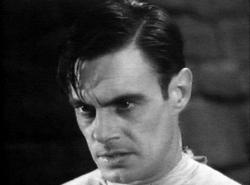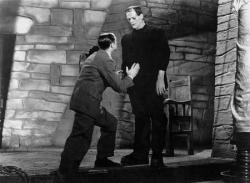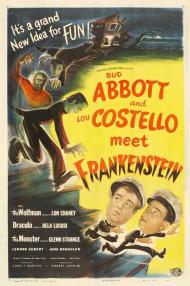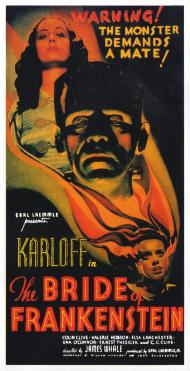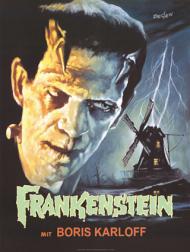



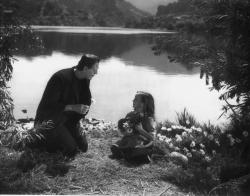
By today's glossy and overtly graphic horror movie standards Frankenstein seems quaint and dated, still if you watch it all alone on a dark and stormy night it is capable of creating a shiver or two. This is due in part to the excellent direction by James Whale, and the creepy performance Colin Clive gives as the brilliant (not to mention mad) Dr. Frankenstein, but most especially to the great Boris Karloff. He imbues The Monster with a sublime yet deranged humanity, moving about - for all the world - like re-animated dead flesh. The interaction between him and the little girl by the lake, in one of the movie's most famous scenes, is equally horrifying and tragic because of the innocence of both characters.
Frankenstein, for those very few who may not know, is the story of a scientist obsessed with creating life from dead human tissue. (Can anyone say God complex?) He steals body parts from graveyards and a brain from a medical school, which turns out to be the abnormal brain of a criminal. He then, literally, sews the parts together, and brings the creature to life by harnessing the electricity in lightning during a storm. Intoxicated by his success he gleefully shouts the movie's best-known line. "It's alive. It's Alive! IT'S ALIVE!!!"
Frankenstein's humpbacked assistant torments The Monster with fire. In self-defense the misunderstood creature kills the assistant, then busts loose before he can be dissected and thus destroyed, killing another scientist in the process. Once free the bewildered creature runs around the countryside adding the little girl to his body count. Eventually the local townspeople form a mob and chase him to an old windmill where the movie reaches its brutal climax.
This movie also stars Mae Clarke as the female lead. She is best remembered for getting a grapefruit in the kisser by a pajama-clad Jimmy Cagney in The Public Enemy.
What is most interesting about this movie is how sympathetic it is towards The Monster. Of the three murders he commits, two are in self-defense and the other is from pure ignorance, there is no intentional malice. In fact, he is as much a victim as anyone else in the story. Perhaps as a gay man living in the nineteen-thirties, James Whale was making a statement about the way our society reacts to someone that is different from the majority.
Political or not Frankenstein is a cinematic masterpiece that will still be entertaining audiences five hundred years from now.