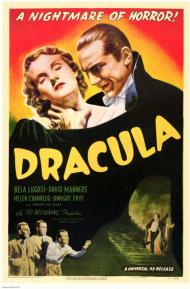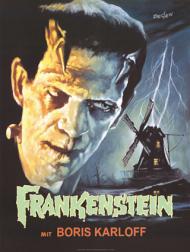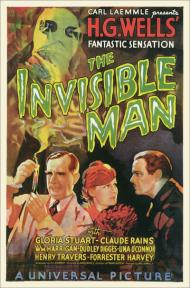



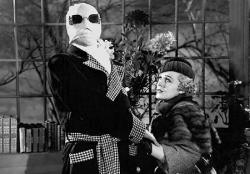
The Invisible Man is, along with Frankenstein and Dracula, one of the classic horror movies made by Universal Pictures in the early 1930s. It was directed by James Whale and launched the celebrated movie career of its star Claude Rains. Rains was cast for the “intellectual” qualities of his voice and his clear enunciation. He is only actually seen for a moment in the film's final shot.
Based on the classic H.G. Wells novel, first published in 1897, it features a script that adheres closer to its source material than either Frankenstein or Dracula had. Wells was still living at the time and he was reportedly disappointed in the portrayal of his central character. In the movie he is written as more of a psychopathic madman than in the novel.
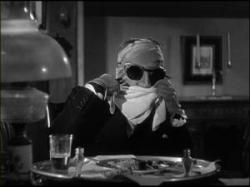
The story jumps right into the action and never lets up in its 70 minute run time. It begins with the arrival of a mysterious stranger at a country inn in England. He's wearing an overcoat, a hat, gloves and dark goggles, and his entire face is covered in bandages. He demands a room and that he be left completely alone.
The shocking revelation that this is an invisible man comes quickly as he shows himself (or rather lack of self) to the inn keeper's wife before escaping to wreak havoc on the surrounding countryside. The rest of the story concerns the police's efforts to find him, with a subplot involving two fellow scientists and the daughter of one of them that was romantically linked to Dr. Jack Griffin (the invisible man).
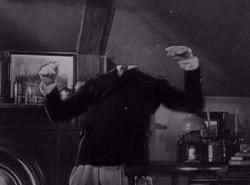
The special effects hold up remarkably well. They include the Invisible Man riding a bicycle in one scene and him lighting and smoking a cigarette in another. They are simple but effective and cleverly executed. The Invisible Man is also shown in various stages of dress. Sometimes he appears as a disembodied shirt riding in a car or as a pair of pants dancing down the road. His gleefully wicked laugh punctuating the night.
The Invisible Man has a higher body count than most horror movies of that time. He commits several murders on camera and it is mentioned that he has killed a total of 20 men in the search party looking for him. Later he causes the derailment of a passenger train that inflicts death on another 100 innocent people.
The one aspect of the movie that seems dated is in the frightened manner in which his victims react. Whenever he chokes someone they just lie there helpless from terror without even trying to pull his hands off of their necks. If you can look past this fact then the movie is a gripping and fast-paced horror classic. Keep in mind the concept of an invisible person was far more fantastic, and therefore scarier, in 1933 than it is today.
In addition to Rains, the cast includes several famous actors. Henry Travers is best known for his role as the angel Clarence in the perennial holiday classic It's a Wonderful Life. Here she's young and beautiful, but Gloria Stuart found her greatest fame late in life as the older Rose in Titanic. Character actress Una O'Connor steals a few scenes as the inn keeper's wife and her performance was reportedly H.G. Wells's favorite in the movie. Walter Brennan and John Carradine each appear briefly, as the man whose bicycle is stolen and a Cockney villager, respectively.
The potent combination of the visual effects and Claude Rains masterful vocal performance are what make this a great movie. Rains delivers his lines with a chilling inflection. It will give you the creeps when he says, “An invisible man can rule the world. Nobody will see him come, nobody will see him go. He can hear every secret. He can rob, and rape, and kill!”
The Invisible Man deserves all the accolades it has received over the decades. It belongs in the pantheon of indelible movie masterpieces.