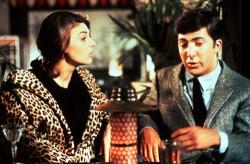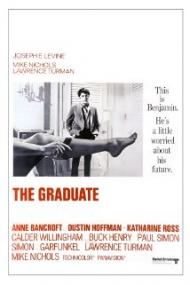



The Graduate is, without a doubt, an iconic American classic that helped redefine cinema at the height of the counter culture revolution of the late 1960s. It was groundbreaking in its depiction of sex, as well as in its camera movement and editing style, and hugely influential in its use of pop songs to underscore scenes. Mike Nichols won the Best Director Oscar in what was just his second time at bat. The Graduate also launched the career of Dustin Hoffman who would go on to be one of the great male movie stars of the latter half of the 20th Century.
Based on the 1963 novel of the same name by Charles Webb, this is the story of Benjamin Braddock, the titular scholar. This movie depicts the events of his first post-college summer, spent at his parent's house in Southern California. Benjamin has no plans for his future and he's overwhelmed with a feeling of isolation (brilliantly depicted by Nichols in several scenes, most notably when Benjamin is submersed in scuba gear in his parent's swimming pool). There is the famous scene where he gets one word of advice from a friend of his parents, “Plastics.” But Benjamin is content to spend his time lazing about the pool soaking up sunshine.
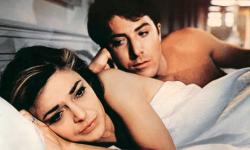
And then he takes Mrs. Robinson home from a party one evening. She wastes little time cornering him in her daughter's bedroom and disrobing, prompting Benjamin's famous statement of the obvious, “Mrs. Robinson, you're trying to seduce me.” The scene where they have their first tryst at the hotel is hilarious (it includes a comic turn by Buck Henry who also adapted the screenplay). In fact it is almost too funny for the rest of the movie, which has a decidedly more dramatic tone.
This shift begins to occur when Benjamin discovers that he and Mrs. Robinson (none of the middle-aged adults in the movie are given first names) have nothing in common but sex. After much prompting he does get her to open up a bit about her past; she reveals that she was pregnant when she got married. But she makes it clear that sexual gratification is the only thing she requires of him.
The real shift in tone happens when Benjamin reluctantly takes Mrs. Robinson's daughter Elaine out on a date. From this point on there are only occasional glimmers of humor. He is at first purposefully rude, even going so far as to take her to a sleazy strip joint. After Elaine breaks down sobbing, Benjamin kisses her and falls head over heels. She leads Benjamin on a chase up to Berkeley before the story heads to its famous climax at the church, where the young lovers make their escape on that bus to nowhere. And all to the tune of Simon & Garfunkel.
When I saw this movie as a teenager in the 80s I remember being completely caught up in the romance between Benjamin and Elaine. I thoroughly believed in their happily ever after. Although to be honest I didn't really spend much time thinking about their future together. Now I realize that Nichols is strongly suggesting the opposite. That it's more likely these two young lovers are destined to turn out similar to their parents. He'll probably wind up in plastics and she'll be a discontented housewife. Despite this one act of youthful rebellion, they aren't really rebels at all.
If anyone in the movie is a rebel, it's Mrs. Robinson, so brilliantly depicted by Anne Bancroft. She's selfish and bitter but at least she has some depth, unlike Benjamin and Elaine who come across as completely shallow. Not to mention lacking in impulse control. But then aren't we all when we're young and in love? The Graduate was undeniably groundbreaking and it remains quite subversively funny during its first half. And, although the second half no longer possesses the romantic intensity it once had for me, now that I see the ending for what it really is, it has actually improved over time.