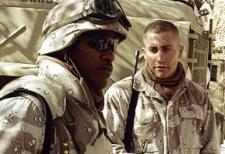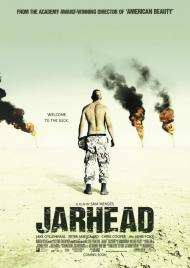



In the same way that modern war isn't the same as war in our grandfather's time, Jarhead isn't the same as war movies in our grandfather's time. That is to say, it has just as many striking differences as it does striking similarities.
Like so many war movies that have preceded it, Jarhead begins with one young man's (Gyllenhaal) enlistment into the military -- this time it's the Marines -- and follows him through basic training and eventually into a military conflict -- this time it's the first Gulf War or as it was affectionately known, Operation Desert Shield and then Operation Desert Storm.
Along the way he meets the usual assortment of military characters that appear in these sorts of films; the crazy guy, the innocent guy, and the career drill instructor who's tough as hell on them, but has a heart of gold underneath. The latter is played by Jamie Foxx who continues to prove himself as an actor, but isn't given nearly enough to do here.
The majority of the movie is spent in the desert during the Shield portion of the war and shows how the Marines cope and sometimes don't cope with the wind, the sand and the mind-numbing boredom of constantly waiting. Perhaps director Sam Mendes wanted the audience to get the feeling of what it was like for the soldiers because like them we are forced to wait for far too long as this portion stretches on and on until we're experiencing the same boredom that the characters are.
The movie and war differ from older movies and wars when Desert Storm begins. Since, if you're old enough to remember, that war seemed to be almost entirely determined in the air, the Marines are left with nothing to do but walk across the desert amongst the dunes and the burning oil wells. The only enemy that is seen is through the scope of a sniper rifle and even then they are deprived of the kill by an air strike. The only death that is shown is the remains of bodies on the ground that were killed from above.
With Hollywood's habit of Bush-bashing I fully expected this movie to make a political statement. However, it is almost completely devoid of politics. When two Marines begin arguing over the political reasons behind the war, another marine (Sarsgaard) cuts them off by telling them, "Shut up. We're here. That's all that matters. All the rest is just bullshit." And given their predicament, it is easy to see his point. When you're there on the ground with no control over your own destiny, the politics behind the war must mean much less than just staying alive.
This lack of a stance though ends up handicapping the movie. Without a clear position, other than the fact that war is hell for soldiers on the ground, the movie conveys no other message, but then maybe that's all it's trying to say.