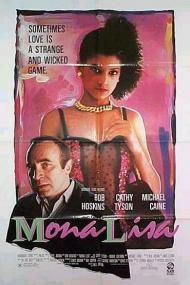



For his role in this film, Bob Hoskins won 10 different awards, including the BAFTA, the Golden Globe, and the Cannes Film Festival award. He was nominated for an Oscar and probably would have won if he hadn't gone up against Paul Newman, who took home the award, supposedly for The Color of Money, but in actuality for his long career. It's a pity that Newman didn't win one for his earlier films, both because he deserved it, but also because Hoskins delivers an Oscar worthy performance here.
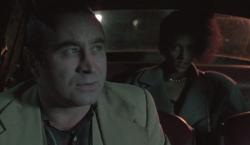
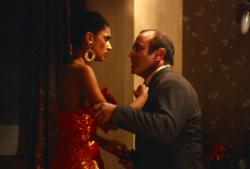
Although not really shot as a film noir, the plot is reminiscent of one. Hoskins plays George, a smalltime gangster who just spent the last 7 years in prison for an unnamed crime. As the movie opens he has returned to his haunts in London where he tries to visit his teenage daughter, which doesn't go well with his ex-wife, and and he also hits up his old boss, Mortwell (Michael Caine), for a job. Mortwell shunts him off with the small job of acting as the driver for Simone, a young prostitute played by Cathy Tyson, the niece of Cecily. At first the two clash, but soon George develops a crush on her, and she convinces him to help her find a young friend of her's; another prostitute that she used to know when she worked the streets. This simple plot leads to a climax where secrets are revealed. The ending isn't a happy one, and you won't be expecting it to be as you watch this melancholy story develop, but it is a satisfying one.
Irish director Neil Jordan (The Crying Game, Interview with a Vampire) scored his first big hit with this film. He brings a rough edge to the movie as it moves among the fleshpots of Soho in London, prior to its gentrification. Think Times Square of the 1980s and you'll have a good idea what it's like. Despite the ugliness, he manages to bring some beauty to his shots. He also co-wrote the script, which provides some great lines and several fully developed characters in a story that takes American crime film conventions and adds the British class structure to the mix.
Cathy Tyson won a few awards herself for her part and she does good work. She is the Mona Lisa of the title, or at least to George she is. He projects onto her what he wants to see, in the same way that people have been interpreting the famous smile of that painting for centuries. It isn't until near the end of the film that he and we truly see her, although it's easier for us as the audience to guess the truth than it is for George. Simone is by appearances, the exact opposite of George. She's tall, thin and unemotional, next to his short, overweight volatile personality.
Rarely does Michael Caine deliver a bad performance and this isn't one of them. He makes a terrifically slimy villain, smiling one minute and turning vicious the next. He deals in women and secrets and discards, abuses and sells them at his whim. It's a very small part, with probably less than 10 total minutes of screen time and yet he looms over the story.
As good as his co-stars are though, this is Hoskins' picture. Short, overweight and with quite a lot of body hair, he makes an unlikely leading man. More typically someone of his physique would be a character actor and indeed, in his later career he became exactly that, but for a short while he was able to headline a film. His performance here is an intense one. He's uncouth and unsophisticated, but also sensitive. Capable of anger and violence, but he never comes across as cruel or mean. His feelings for Simone are genuine. He spends the majority of the film in over his head and although we never feel that he truly understands all that's going on around him, at least until the end, we want him to find his way. The year after this movie, Hoskins would star in Who Framed Roger Rabbit, the film he will forever be the most associated with, but it's in this one that he demonstrates his greatest acting skill.
There's a sadness that pervades this story, but in the very best way. It will stay with you long after the credits have rolled.