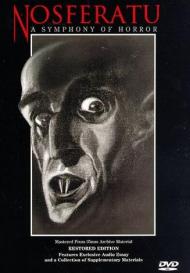



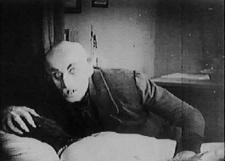
Nosferatu is the first filmed adaptation of Bram Stoker's Dracula, although since they didn't have the rights to use the novel or its characters, they simply changed the title and the names. Despite these cosmetic changes and a few points in the story that differs from the book, this is still, quite obviously, the story of Dracula. In fact, after the movie was released, Bram Stoker's estate sued the maker's of Nosferatu for copyright infringement and won. Despite this, many of today's copies of the film have gone ahead and changed the names on the cutscene cards to match the names in Dracula.
The plot, for those unfamiliar, tells of a young real estate agent (Harker in the novel, Hutter here) who is sent into the Carpathian Mountains in Transylvania to meet with a mysterious old Count (Orlock in this version) who wishes to buy property in a city. When Hutter meets Orlock he discovers a hideous, rodent like old man with a blood fixation who gives him the creeps. He also wakes up after his first night in the Count's castle, with two strange and bloody marks on his neck. The Count leaves quickly after signing the papers Hutter has brought him and travels by boat to the city, leaving Hutter trapped in his castle. Upon arriving in the city, Orlock goes on a killing spree, causing what the townsfolk believe to be a sudden attack of the plague. Eventually it is up to Ellen (Nina in the novel) to do what she thinks must be done to destroy the vampiric menace.
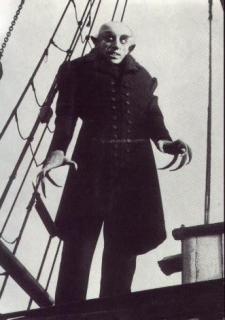
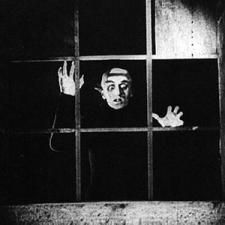
Undoubtedly the best thing this movie has going for it is Max Schreck as Orlock. He's no suave or seductive vampire. His ears are long and pointed, as is his nose and fingernails. His bald head and bushy eyebrows add to his rodent-like features and he's creepy looking as hell. And his stiff gait and odd movements really add to that creepiness. The director also makes good and interesting use of the shadows this strange creature casts, something that Francis Ford Coppola would imitate and expand upon in his version of Dracula.
With Schreck being the best part of this movie, the worst part of it is that he's not in it nearly enough. He's only on-screen about 10 or 15 minutes out of the whole movie. Of course, this isn't just this movie's fault. If you've read Dracula, you also know that this is true of the novel as well. There's just far too much time spent on Ellen and Hutter, both of whom overact even by the standards of the 1920s.
Production values on the film are quite good for the period. Several special effects are done well, including extended use of stop motion photography to imitate Orlock's ability to move things with his mind. Perhaps the most famous scene from the movie is the moment when Orlock rises from his coffin on board the ship when he raises himself from being prone to standing without ever bending his body.
As one of the first horror films and the movie that set a lot of the standard things we think of in vampire movies, you have to give Nosferatu credit. Despite all that though, the movie as a whole is lacking. It contains some iconic moments, but too much of it, i.e. any scene without Orlock, is less than stellar.