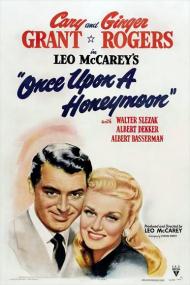


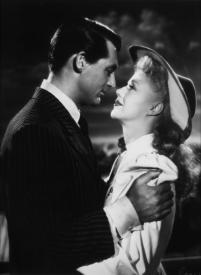
During World War II, Hollywood made many films that called out the enemy. Once Upon a Honeymoon goes to great length to inform the American audience on the evils of Hitler. It was in fact, one of the first films to do so. The most notable exception being Charlie Chaplin's The Great Dictator (1940) but whereas Chaplin did not name the Nazi's as such, Once Upon a Honeymoon does.
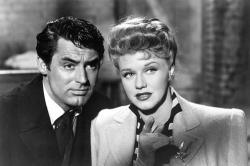
The film opens in Vienna with American Katie O'Hara (Rogers) preparing for her wedding to an Austrian Baron. She is a former burlesque stripper, who put on airs to climb the social ladder. Pat O'Toole (Grant), an American reporter, is investigating the Baron, who he believes is working for the Nazis. Katie knows nothing of her fiance's connections.
She marries the Baron and they travel Europe as one country after another falls to Germany. O'Toole is always close behind reporting on the events. He starts falling for Katie and eventually convinces her that her husband is a Nazi. With that understanding O'Hara fakes her own death and runs away with O'Toole. After surviving capture and questioning and a ship being sunk, O'Toole and O'Hara end up in Paris where an American secret agent recruits her to spy for the allies.
Although billed like it is a romantic comedy, Once Upon a Honeymoon is really just a political commentary helping to justify The United States government's decision to declare war on Germany, which happened on December 11, 1941, a year prior to this film's release . At one point Katie helps a Jewish woman and her children leave the country by giving them her passport. Pat has a habit of breaking into political rants about how the Nazis take away German citizen's freedom and choices. In another scene Katie and Pat talk about how Hitler controls who can and who cannot have children.
My favorite political line in the film is when Cary Grant says, "Not so loud? I always talk loud when I'm mad! You're lucky I don't jump up and down! It's things like this that can make a man a... a... a republican!" The funniest line is when Hitler parades into town and Grant says to Rogers, "Hey, Hitler is here." and Rogers responds nonchalantly, "Well I can't see him now. I'm dressing." The scene where Grant does the news report with the Baron is one of the film's best.
The premise for this film is much more exciting than the actual product. It is not as romantic, funny or thrilling as it could have been. It tries to encompass too much of the war. Katie goes from being a Baroness to a refugee to a spy. All along being romanced by Grant. The story needed to be better focused on a singular event. As it is, this is just a time capsule of propaganda.