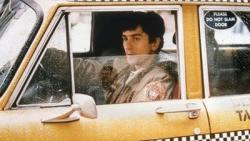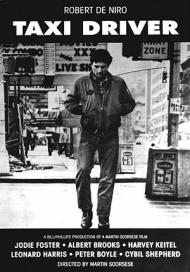



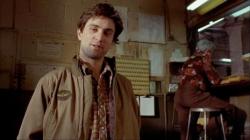
This is one of those famously iconic movies that people are aware of even without having seen it. De Niro's, "You talkin' to me?" scene is familiar to every movie buff. It was named #10 by the AFI on their 100 Years...100 Quotes list. As a whole though, how does the movie hold up 35 years after it was released? Despite being a bit rough around the edges, surprisingly well.
De Niro plays Travis Bickle, an unstable Vietnam vet in 1970s New York City. An insomniac on medication, he takes a job as a Taxi Driver, working nights, from 6PM to 6AM. Nightly he drives across the city, seeing only the ugliness and brutality that the city has to offer. Through the voiceover narration, we learn exactly what Bickle thinks of it all, "All the animals come out at night - whores, skunk pussies, buggers, queens, fairies, dopers, junkies, sick, venal. Someday a real rain will come and wash all this scum off the streets."
It has little to do with the plot, apart from showing the setting and introducing the characters, but these early scenes of Bickle prowling the city, mowing down the steam rising from the sewer grates, with the neon light reflected surreally in the windshield, are some of the most interesting and memorable. It's a dark and twisted world that he inhabits and we're taken along for the ride.
For a short while Bickle becomes smitten with Betsy, a political volunteer working for a presidential candidate. Their "relationship" doesn't last long though, ending before it begins when he takes her to an adult movie theater on their first date. It's her rejection that pushes the already deranged Bickle even further off the deep end.
Clearly Bickle's biggest problem is his isolation. As he says, "Loneliness has followed me my whole life. Everywhere. In bars, in cars, sidewalks, stores, everywhere. There's no escape. I'm God's lonely man." He longs to make a connection, but he doesn't have a clue how to relate to another human being. After purchasing some guns, he suddenly thinks he sees a way to make that connection, or at least a way to make an impact on the world.
The only person that Bickle does manage to form a connection with, is Iris, a very young prostitute played by Jodie Foster. As she puts it, "I don't know who's weirder. You or me?" In one of his few acts of humanity, Bickle offers to help Iris escape her troubled life.
Scorsese generates plenty of atmosphere. There's a gritty look and feel to the story that perfectly captures 1970s New York City. There's nothing glossy or pretty here, apart from Shepherd as Betsy. And except for the obtrusively dramatic soundtrack and the hyper-violence of the film's climax, there's a very realistic feel to the story.
De Niro's contribution is that with Bickle he creates an unstable killer that you sympathize with. He is crazy but vulnerable. Innocent and psychotic. He is, as Betsy describes him, "A walking contradiction."
My only real complaint with the story is the epilogue, which seems a little too neat. Too Hollywood. Roger Ebert, among others, has conjectured that this ending takes place inside Bickle's mind rather than in reality, but Scorsese has contradicted this theory. It doesn't really mar the movie as a whole, but it does mean that it ends on a weaker note than if it had ended without it.
If you only know this movie because of that one famous scene with that most famous of lines, then you definitely owe it to yourself to watch it. Particularly now that Scorsese and De Niro have actually been talking about making a sequel all these years later. Perhaps they should talk to Coppola about the wisdom of reviving a beloved film from the 70s, but either way, if they make it, I'm sure I'll see it.