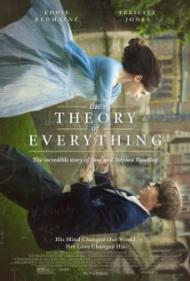



It's the middle of November and the award's season hopefuls are getting more numerous by the week. With the the release of The Theory of Everything you can add Eddie Redmayne's name to the pile. His portrayal of the physical deterioration of world famous physicist Stephen Hawking is the kind of showy performance that the Academy eats with a spoon.
While most people are familiar with the image of Stephen Hawking in his electric wheelchair with his voice synthesizer, how many of us know the story of how he got there? This movie tells that story, with a heavy emphasis on his early years as a physicist and his relationship with Jane, his first wife. Since the script was inspired by the memoir Traveling to Infinity: My Life with Stephen by Jane, perhaps this is unsurprising. The plot places heavy emphasis on their romance and keeps the science details light. The result, especially for the first half of the story, is a moving one featuring two sensitive central performances.
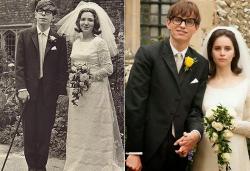
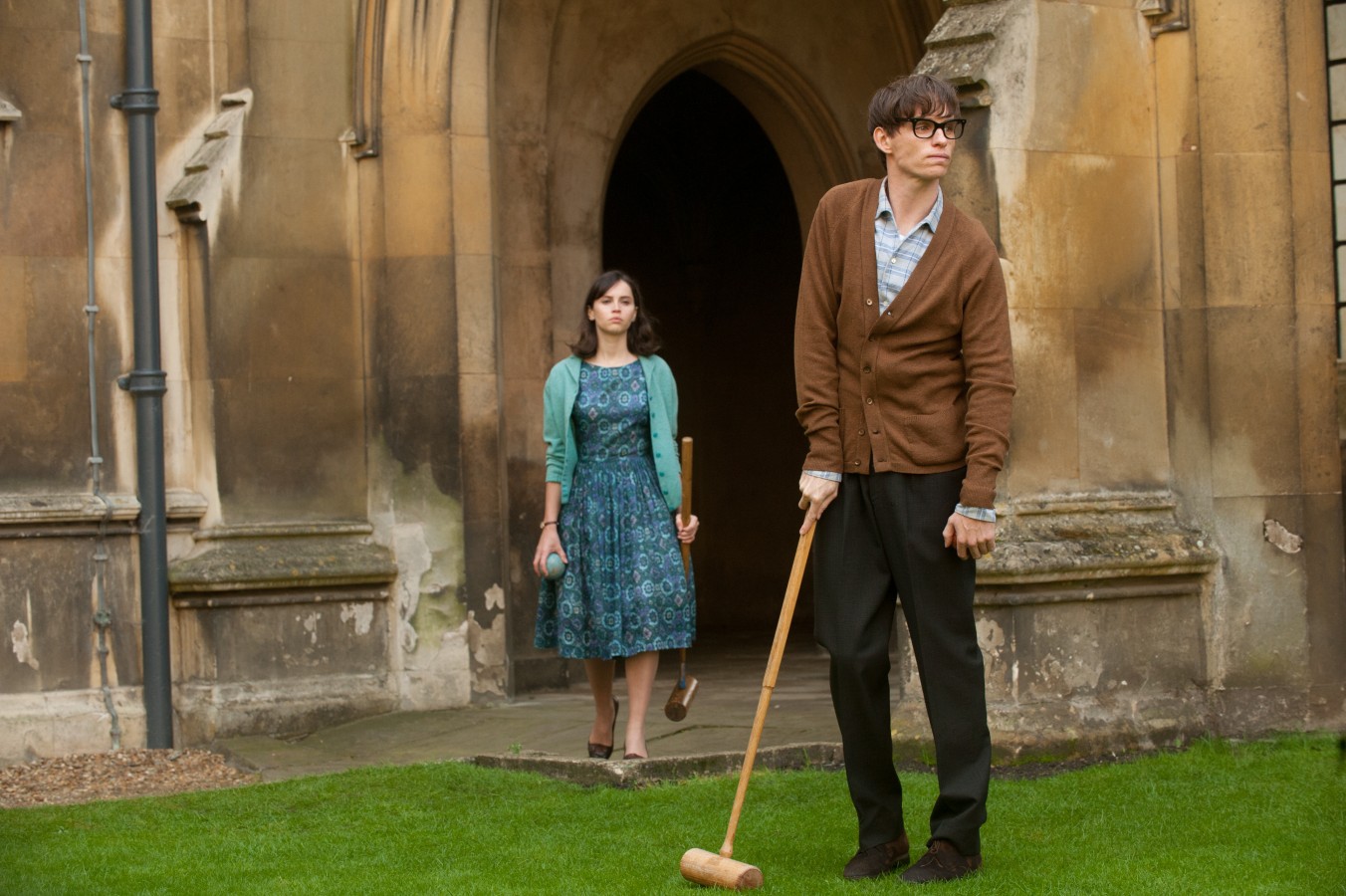
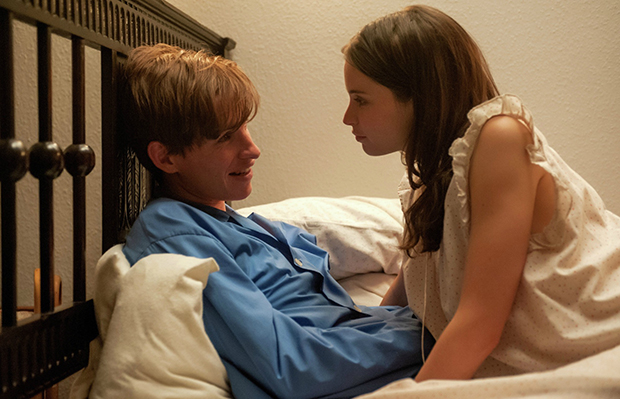
The story begins at Cambridge in the 1960s when Hawking is a physicist student. His world is changed when he meets Jane Wilde, a language student. Despite her religious views and his adherence to science, the two are soon in love. Soon that love is put to the test when Stephen is diagnosed with ALS (Lou Gehrig's disease) and is given just 2 years to live. Wishing to share what time they can together, they get married and start a family with their first two of three children born within their first 5 years of marriage. A third would be born nearly a decade later. Over the years their love is tested as Jane must cope with raising the children while also dealing with a husband who becomes more infirm by the year, but who cotinues to beat the odds of survival.
It is Redmayne's portrayal of Hawking that is generating the biggest buzz in the film and deservedly so. He begins as a physically and socially clumsy young student and then progresses through the various stages of ALS, physically transforming himself as the disease takes its toll. His acting is even more laudatory when you learn that since the film was shot out of order, as most films are, he was required to perform any one of the stages of the disease on any given day. Such was his dedication to the physical side of the performance that doctors are saying he may have altered his spine's alignment permanently (or at least so says the publicity department). Although the physical transformation is the most obvious, Redmayne's performance goes deeper than that and at every stage of the disease you always know what is going on inside of Hawking. Using just his eyes and a limited range of motion in his face, Redmayne is able to convey the spectrum of emotions. It's the kind of part that can put a young actor on the A-List, and Redmayne makes the most of it.
Although she's over-shadowed by her co-star's flashier performance, Felicity Jones as Jane should also garner some awards' attention. Since this is a British film, the overt display of emotion is kept to a minimum, but Jones delivers the kind of reserved, stiff-upper-lip, filled with repressed feelings performance that the British excel at.
If this story were purely a Hollywood crafted one, it might have ended less messily. But as this is a true story, the path of love doesn't run precisely smoothly. Anyone familiar with Hawking's life will know what I mean, but I won't give it away here. This doesn't really mar the film, but it does create a rather melancholy ending. But also it's an inspiring ending. When you see what this man and this couple had to go through and what they were able to accomplish anyway, it might put your own problems into some kind of perspective.