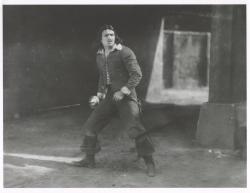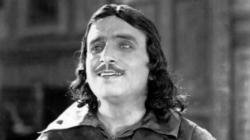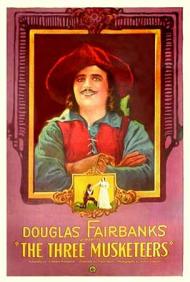



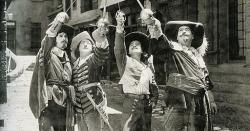
After the success of The Mark of Zorro (1920), Douglas Fairbanks starred in and produced Alexandre Dumas' classic The Three Musketeers. It seemed like the perfect choice for him. It is another swashbuckling role with the potential for plenty of action. Although it is by no means the best version, it is one of the first and we must wonder how it influenced later interpretations.
Fairbanks stars as young D'Artagnan, who goes to Paris to fulfill his dream to become a member of the King's royal swordsmen known as The Musketeers. Soon after arriving in Paris he meets and befriends three of the best Musketeers, Aramis, Porthos and Athos. D’Artagnan also meets and fallis in love with Constance, a maiden to the Queen. He soon finds himself caught up in palace intrigue, involving a royal affair and at odds with Cardinal Richelieu, who is trying to use the affair as a power grab.
As this is a Fairbanks production, I waited in earnest for the action to begin. It was not until nearly the 40 minute mark before he did any sort of acrobatic maneuver. Fairbanks was not much of an actor. The only time he is interesting on screen is when he is moving. The pace picks up once all the characters are established and the plot is set in motion. This starts with D’Artagnan rescuing Constance and carrying her over roof tops to safety.
In the original credits, Fairbanks insisted he be listed last. He knew he was the star and did not need to brag about it. Also in the cast is Adolphe Menjou as King Louis XIII. He would go on to a long career playing alongside such other stars as Gloria Swanson and Rita Hayworth. Eugene Pallette would go on to success in remakes of Douglas Fairbanks’s films, The Adventures of Robin Hood (1938) with Errol Flynn and The Mark of Zorro (1940) with Tyrone Power.
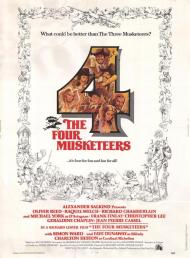
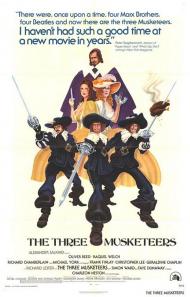
Although the 1974 version is my favorite, this version has much to offer. Besides watching Fairbanks in action, there are some humorous moments. D’Artagnan’s assistant is described as a man who spits into the river to see which way it flows. The poor guy gets fed from the table like a dog.
Marguerite De La Motte is by no means Raquel Welch, whose Constance was a fairly easy lay compared to this one, who is more of a tease. She flirts with D’Artagnan to get him to get the jewels back for the queen. D’Artagnan moves in for a kiss but Constance puts her hand between their lips and says, “When you come back.”
Silent film directors had to convey emotions without lots of dialogue. Often this was done with broad arm waving and over-acting. Sometimes though, it was more subtle, such as when Cardinal Richelieu schemes we see his hand caressing the arm of his chair. There is also a scene where he strokes a cat. Something we would see Blofeld do when contemplating the demise of James Bond and mob boss Vito Corleone do when in a meeting.
Fairbanks films were about the big action pieces and his stunts, such as when he climbs over a gate by way of a man’s back. Those scenes are however surprisingly few and far between. The Three Musketeers is not my favorite of Fairbanks’s films. There is just too much story here for him to handle.