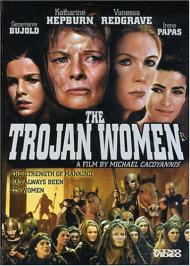



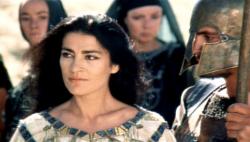
The Trojan Women was written sometime around 400 BC by Greek playwright Euripides. This English translation by Edith Hamilton was originally used on Broadway in 1938. This film adaptation is a bit staged and the dialogue is often long and dramatic but also quite memorable. The Trojan Women requires a bit of patience from the audience as you must listen closely and excuse the over acting so required in a Greek tragedy.
After a decade long siege, Troy has fallen to the Greeks and every male citizen has been killed. The gold and riches of the city has been confiscated. The children have been taken away. All that remains of the ruined city are the female population. This includes queen Hecuba, mother of Hector and Paris. With her is her daughter Cassandra, whose sanity has taken a vacation.
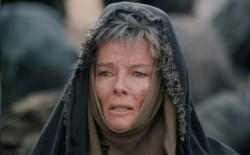
Katharine Hepburn as Hecuba carries the film through all three acts upon her very capable shoulders. Her Hecuba is very reminiscent of Eleanor of Aquitaine from The Lion in Winter (1968). Both were desperate royal women fighting for survival.
In the first act we learn that lots were drawn and all the women are to be taken back to Greece for whatever purpose their new master may dictate. Hecuba is to become a slave to the Greek king. Cassandra is to be taken away and wed to a Greek, "If God still lives, my marriage will be bloodier than Helen's." Cassandra states. Genevieve Bujold is good as the insane, yet wise Cassandra. "This truth stands firm... the wise will fly from war, but if war comes, to die well is to win the victor's crown."
The second act sees the arrival of Andromache, widow of Hector. She arrives under Greek guard with her son. Vanessa Redgrave is astonishing as Andromache. No sooner does she arrive than she is told that her son is to be killed and she become a member of the Spartan king's harem. Redgrave lets out a wail that only a woman in her situation could produce.
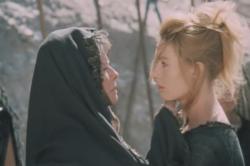
Lastly we meet the woman who started it all, Helen, played by Irene Papas. Her first appearance is quite memorable. When a soldier tries to bring the parched women water, they mob him and the water is taken away. We then see Helen under the watch of a guard, whom she asks for water. He slides her a pan full. She then strips and bathes in it in full view of the outraged women.
Papas has the smallest of screen time but her scene with Hepburn is the movie's best. She defends herself by blaming Paris, Hecuba and even Aphrodite. "Who began these evils? She, the day she gave birth to Paris." She tries to get pity from the women and guards. She even cries on a guard's shoulder cursing her own beauty. Hecuba is however, having none of that. "The Gods will fight on my side while I show her to be the liar she is." Hecuba says to the women before starting in on Helen, "Never make gods out of fools to whitewash your own evil. My son was beautiful, exceedingly. You saw him. Your own desire was enough, no need for any Goddess."
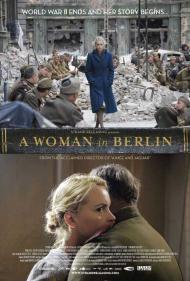
The Trojan Women is loaded with great performances and dialogue. When some women try to comfort Hecuba, she says. "Let me be. Kindness unwanted is unkindness." The Academy ignored this limited release film. It was not a box office hit. Many claim it to be an anti-war film, being that it came out during the Vietnam war. As with the German made A Woman in Berlin (2008), The Trojan Women demonstrates that while the men die in battle, it is the women who endure defeat.