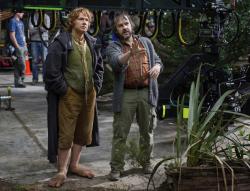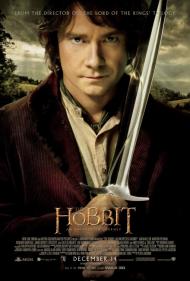



It was in 1995 that Peter Jackson first expressed an interest in making a film based on The Hobbit. He envisioned it as part one of a trilogy. The second two parts would comprise the story of The Lord of the Rings. Complicated copyright ownership prevented him from making The Hobbit first and so he started with the LOTR films. Now he finally has the chance to tell the tale that started it all. Since splitting one book into multiple movies has now become the accepted norm, instead of adapting one book into one film, the same story he was going to tell in three movies, will now have taken six. You have to wonder if he were starting on filming The Lord of the Rings today if he wouldn't have turned the whole series into 12 movies.
There's more of a negative buzz in the media surrounding this film than there ever was about LOTR, and it seems to be because of this decision to pad the story into three films. Jackson and others have said that by splitting the story into three parts they can expand the tale and show more details and backstory. Is that the real reason though? Or is it simply an attempt to triple the profits that could be made from one movie? Even if the choice to make a trilogy is an artistic one, is it the correct choice? The Hobbit is a much lighter, faster paced story than LOTR. There are hints of darker things and mention of events past, but essentially it's a children's story. Does it really need three movies to tell it?
The tale of The Hobbit is a simple one, or at least it is in the book. A group of dwarfs, lead by Thorin Oakenshield, set out on a quest to reclaim their kingdom from Smaug the Dragon. They are joined by Bilbo Baggins, the Hobbit, and Gandalf the Wizard. A great deal of the story describes their journey to the mountain where Smaug lives while the final third deals with the confrontation with the dragon and its aftermath.
Jackson has lengthened the tale by showing things that are only briefly mentioned in the book and by showing things that take place offstage in the book. He also occasionally takes a scene that is just a few throwaway lines in the book and stretches it out considerably. A prime example of this is the Stone Giant scene. Where in the book they are mentioned in one paragraph when Bilbo sees them across a valley during the thunderstorm, in the film they become a giant CGI filled action scene.
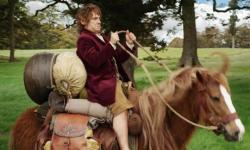
The cast is superb. Martin Freeman makes a perfect Bilbo and it's easy to see him as a younger version of Ian Holm's Bilbo from LOTR. Richard Armitage is terrific as Thorin and makes the Dwarf King more threatening and regal than I ever pictured him in the book. Fans of old school Doctor Who will get a nice surprise when former Doctor Sylvester McCoy turns up playing Radagast the Brown. There are several returning faces from the LOTR films, some as mere cameos, while others have larger parts. When originally announced, I'd always hoped Sean Connery would play Gandalf, but now I can't imagine him without thinking of Ian McKellan who returns to the part and delivers yet again another powerful performance.
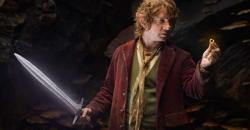
As he did in the earlier trilogy, it is Andy Serkis as Gollum who almost steals the movie, despite being in just one long scene near the end of the film. Tolkien's most famous chapter from the novel, "Riddles in the Dark", where Bilbo first finds the ring and he and Gollum match wits over a game of riddles, is reproduced faithfully and well. It's the highlight of this movie and possibly the series. It will make you feel bad knowing that it's the wretched creature's only appearance.
Although Jackson stretches out the story, he does provide bang for your movie going buck. His filler is action packed filler for the most part. There are plenty of things that could have been cut without losing the essential tale of The Hobbit, but the added scenes are entertaining. It does however, mean that this movie is a three hour butt numbing affair. It's entertaining, but just when a good thing becomes too much of a good thing will vary from viewer to viewer.